
table of contents
A training coordinator for a wilderness EMS program asked us last quarter to quote 1,200 tourniquets, and his spec sheet listed the SWAT-T as a one-for-one replacement for the windlass units his teams already carried. He had read that the SWAT-T was lighter, cheaper, and could double as a pressure dressing. All true. The problem was the assumption underneath the request: that a SWAT-T and a CAT-style windlass tourniquet do the same job. They don’t.
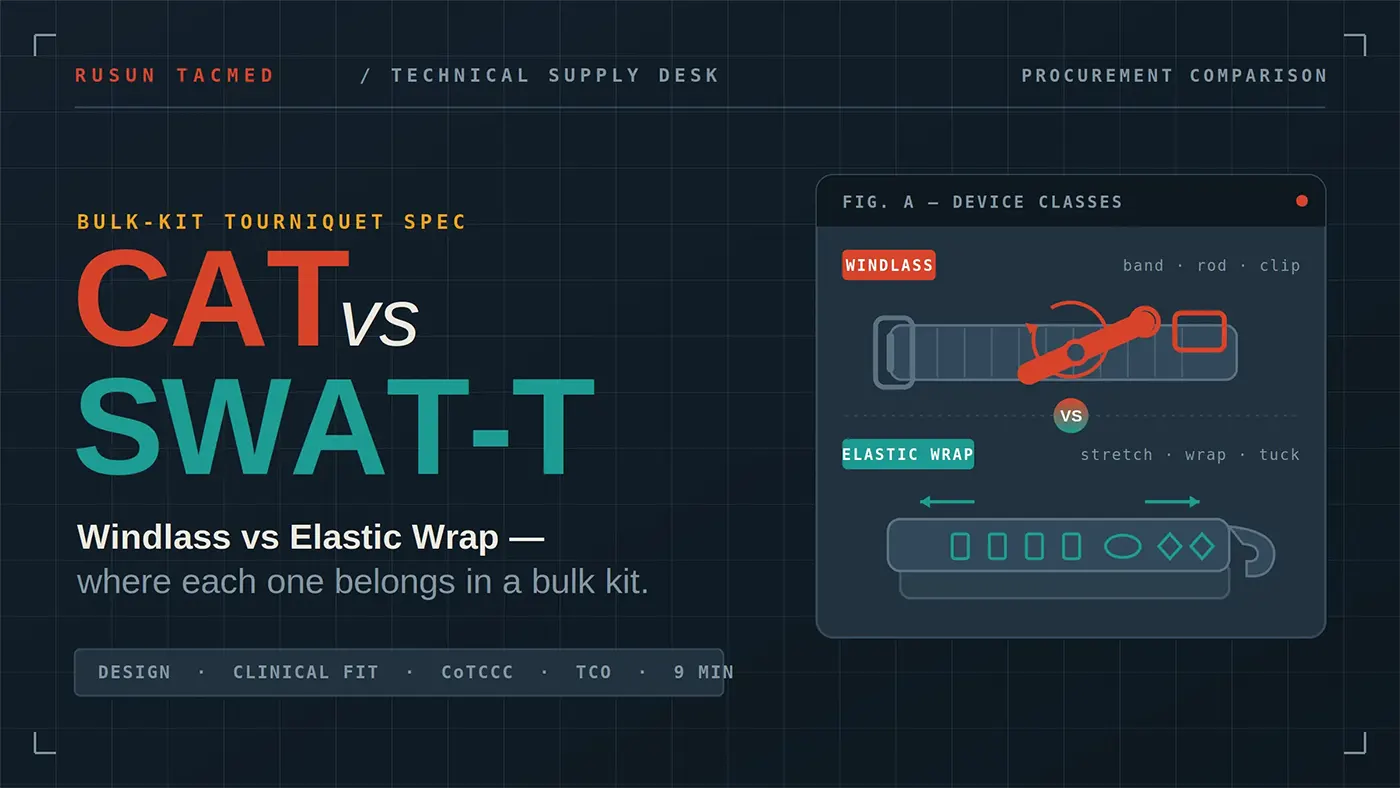
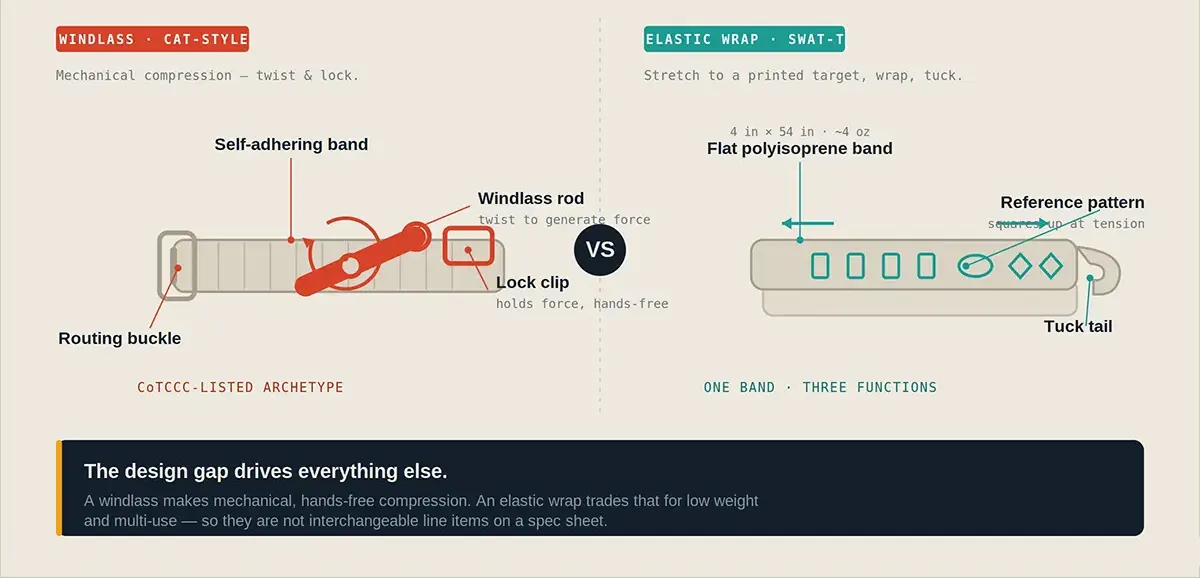
CAT and SWAT-T are not two versions of one tool. They are two different classes of tourniquet that happen to share a search box: a windlass (the CAT-style class) and a flat elastic wrap (the SWAT-T). Treating the cheaper one as a drop-in for the other is the single most expensive mistake in tourniquet sourcing. We call it the “Substitution Trap“—and it belongs nowhere near your purchase order.
Bottom line up front: for adult extremity hemorrhage—the core use case in almost every trauma kit—a windlass CAT-style tourniquet is the primary device, and the SWAT-T is not a substitute for it. The SWAT-T earns its place in a different role: small-limb and pediatric applications, high junctional wounds a rigid windlass cannot reach, and multi-purpose use as a backup or pressure dressing. Most serious programs stock both in a deliberate ratio—not one instead of the other.
Quick Specs: CAT-style Windlass vs SWAT-T at a Glance
| Attribute | CAT-style (windlass) | SWAT-T (elastic wrap) |
|---|---|---|
| Device class | Self-adhering band + twist rod (windlass) + locking clip | Flat elastic band, polyisoprene rubber |
| How compression is held | Mechanically, by the locked windlass | By stretch tension + tucked tail |
| Size / weight | Rigid windlass assembly | ~4 in x 54 in, ~4 oz |
| CoTCCC primary-device list | Yes (windlass/ratchet class) | No (supplementary use only) |
| One-handed self-application | Practical | Difficult |
| Small / pediatric / K9 limbs | Can spin below a minimum circumference | Occludes small limbs |
| Functions | Tourniquet only | Tourniquet + pressure dressing + bandage |
| Best buyer fit | Adult extremity self-aid programs | Pediatric-capable, K9, weight-limited, backup |
Device naming: “Combat Application Tourniquet” (CAT) is a trademark of North American Rescue; this article uses “CAT-style” to mean the windlass class it represents. The SWAT-T (“Stretch, Wrap, and Tuck”) is made by TEMS Solutions, LLC (Safeguard Medical). Specifications above are from manufacturer IFUs and the cited studies.
Key Takeaways
- A windlass CAT-style and a SWAT-T are different device classes—price is not the axis that should decide between them.
- For adult extremity hemorrhage and any program where self-application is plausible, the windlass is primary; the SWAT-T is not a substitute.
- The SWAT-T earns its place where a windlass physically cannot work: small/pediatric limbs, K9, high limb placement, and weight-limited multi-use kits.
- The SWAT-T is NOT on the CoTCCC primary-device list. Reject any quote or datasheet that claims it is.
- Most serious programs stock both in a mission-set ratio, not one instead of the other.
The Substitution Trap: A SWAT-T Is a Different Class, Not a Cheaper CAT
⚠️ The Most Expensive Mistake
Treating these two as interchangeable line items. They share a category name and a search term, not a mechanism. The cost gap that makes the swap tempting is exactly what should warn you it is the wrong comparison.
The CAT-style design is a windlass tourniquet: a self-adhering band plus a rod you twist to generate mechanical compression, locked against a clip. It is the archetype behind the Combat Application Tourniquet (a trademark of North American Rescue) and the windlass class that the Committee on Tactical Combat Casualty Care (CoTCCC) builds its recommended device list around.
The SWAT-T is not a windlass device at all. It is a flat elastic band of polyisoprene rubber, roughly 4 inches wide and 54 inches long, weighing about 4 ounces. You generate compression by stretching the band to a printed reference pattern, wrapping it over itself, and tucking the tail to hold tension. The same band also works as a pressure dressing or an elastic bandage. One tool, three functions — and that design gap drives everything else here.
A point worth stating plainly: the SWAT-T is not on the CoTCCC Recommended Devices List for primary extremity hemorrhage control. That list is populated by windlass and ratchet devices — the CAT Gen 7-style, SOF-T Wide, SAM XT, and TX series. The SWAT-T’s absence is not a quality verdict; it reflects that one-handed self-application is difficult and that occlusion is more technique-dependent than a windlass. If a supplier tells you the SWAT-T is “CoTCCC approved,” that is a factual error you should catch before it reaches your spec sheet.
The Two Variables That Decide This Comparison
Strip away the marketing, and two physical variables settle almost every CAT-vs-SWAT-T call: limb circumference and whether the casualty may have to apply it one-handed. Below a certain limb size, the wrap wins; the moment self-application is on the table, the windlass does.
The Minimum-Circumference Floor: Where the SWAT-T Beats a Windlass
📐 Clinical Note
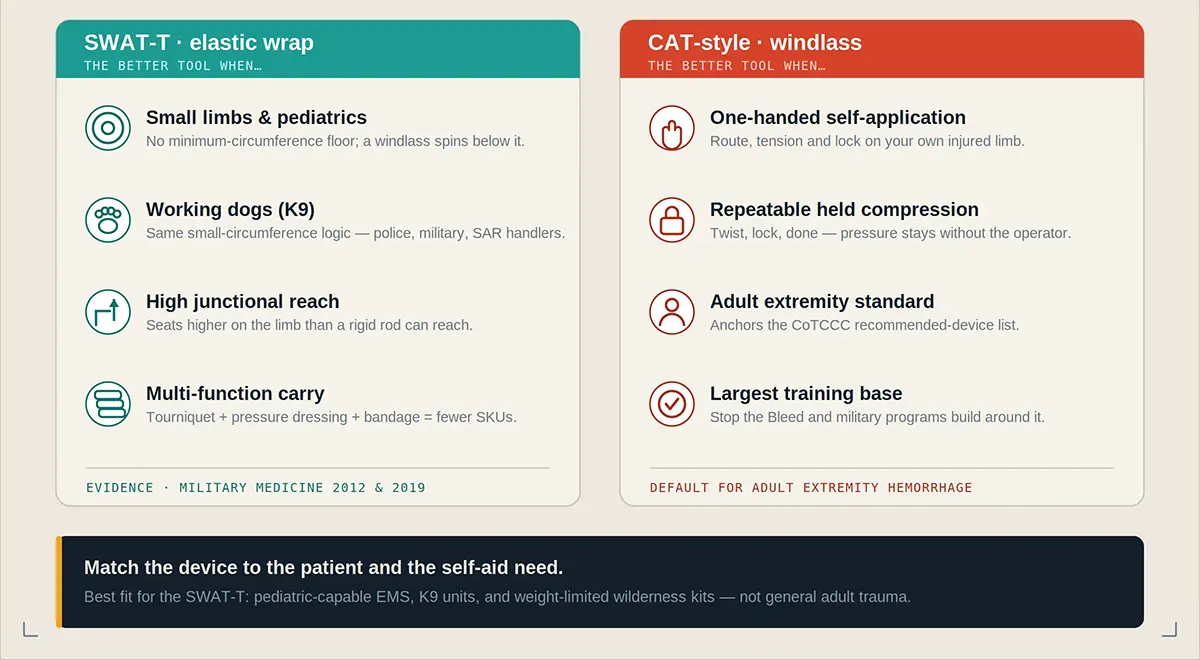
A windlass needs a minimum limb circumference to bite. Below that floor the rod simply spins without generating occlusive pressure. An elastic wrap has no such floor—it tightens to whatever it is wrapped around.
Will a windlass tourniquet work on a child’s arm?
Not reliably. In Sweating the Little Things (Military Medicine, 2019), windlass tourniquets failed to tighten adequately on the upper extremities of 1-year-old pediatric models, while the SWAT-T achieved occlusion across the sites tested. That circumference logic is exactly why the wrap, not the windlass, anchors small-limb kits.
✔ Where the SWAT-T is the better tool
- Small limbs and pediatrics — its strongest evidence base; the wrap has no minimum-circumference floor.
- Working dogs (K9)—same small-circumference logic; relevant to police, military, and SAR handler programs.
- High junctional approaches—the wrap can seat higher on the limb than a rigid windlass, though true junctional hemorrhage still calls for a dedicated junctional device.
- Multi-function carry—one device as a tourniquet, pressure dressing, and elastic bandage cuts the SKU count in a weight-limited kit.
- Trainability with minimal instruction—novice users achieved occlusion after brief instruction in Military Medicine (2012).
In practice, the buyers who get the most value from the SWAT-T are pediatric-capable EMS, K9 units, and wilderness or expedition programs carrying weight-limited kits—not general adult trauma response.
The One-Handed Test: Where the CAT-style Wins
Can a casualty apply a SWAT-T to their own arm one-handed?
Far less reliably than a windlass. A casualty with one functioning arm can route, tension, and lock a windlass CAT-style tourniquet on their own injured limb. Self-applying a SWAT-T to full arterial occlusion is much harder—wrapping under sustained two-hand tension is awkward when one hand is the injury. For any program where personnel may need to treat themselves—law enforcement, military, or lone-worker industrial—this alone tends to settle the decision toward the windlass.
The windlass also gives repeatable, mechanically held compression. Twist to occlusion, lock the rod, and you’re done—and the pressure stays without the operator maintaining it. SWAT-T tension depends on how hard the applier stretched and how cleanly the tuck holds; under stress, fatigue, or blood-slick hands, that is more variable. This is why the windlass class, not the elastic wrap, anchors the CoTCCC list for adult extremity hemorrhage.
We’ve seen this play out in procurement reviews: a buyer drawn to the SWAT-T’s lower unit cost reverses course once the spec is framed around self-aid capability and one-handed application under stress. The cost difference stops looking like savings.
What Each Device Does NOT Do
⚠ CAT-style (windlass) limits
Needs a minimum limb circumference to occlude; a rigid frame cannot seat high in the groin or axilla; it’s single-function (tourniquet only); and it’s a bulkier, heavier line item than an elastic wrap. The groin and axilla gap is not solvable inside the tourniquet class at all; it is answered by a pressure dressing and wound packing, which is the comparison we make in Israeli bandage vs tourniquet.
⚠ SWAT-T (elastic wrap) limits
One-handed self-application is difficult; final tension is operator- and technique-dependent and degrades with stress or blood-slick hands; it is not on the CoTCCC primary-device list; the polyisoprene rubber ages with heat, UV, and time (dry-rot, lost stretch) in a way an aluminum/polymer windlass does not; it is not a substitute for a dedicated junctional device.
Total Cost of Ownership: Price the Device Against the Job
Unit price favors the SWAT-T—single-piece elastic construction is cheaper to produce than a windlass assembly with a rod, clip, and time strap. At volume that gap holds, which is exactly why it tempts buyers into the one-for-one substitution this article warns against. The cheapest line item is not the cheapest program. Price the devices against the job, not against each other.
The variables that drive real program cost:
- Training-unit ratio — both classes offer dedicated trainers (typically blue); budget roughly one trainer per three deployable units for initial qualification, plus practice stock.
- Replacement cycle—inspect daily-carry units every 6–12 months. For the SWAT-T, that inspection means checking the rubber for lost stretch, dry rot, and surface cracking—a failure mode the windlass does not have.
- Mixed-kit logic — if you stock both, set the ratio by mission and document which device is primary so application training stays consistent.
💡 Worked Example: Spending the Program, Not the Sticker
Normalize both devices to a branded windlass priced at 100 cost units. An OEM-qualified windlass equivalent lands near 50–70 of those units (the 30–50% saving), and a SWAT-T-class elastic device lower still. Now spend the program: add one blue trainer per three deployable units, and budget a 6–12 month inspection cycle on every carried unit. The device that is 30 units cheaper on the quote but cannot be self-applied one-handed does not save 30 units—on a self-aid program, it removes the capability you were buying. Plug in your own branded baseline and OEM quote to run the same comparison.
Key takeaway: decide on the device for the job it has to do, then optimize unit cost within that class—never let the unit price pick the class.
How to Read a Tourniquet Quote (RFQ Red Flags)
Two tourniquet quotes are rarely written on the same basis, so comparing headline prices compares nothing. Run every quote through the same checklist before the price decides anything.
- Device class named correctly—a quote that blurs “windlass” and “elastic wrap” under one “tourniquet” line is the substitution trap in paperwork form.
- CoTCCC claims scrutinized — reject any datasheet that lists the SWAT-T as “CoTCCC recommended” for primary control; it is not.
- Windlass mechanical data — request windlass torque data and clip/strap specs for the windlass units.
- Occlusion evidence—band tensile test and occlusion pressure test data, not just a photo and a price.
- Elastic aging data—for the wrap, confirm stretch tolerance and material-aging (UV/heat) data.
- Documentation — a Certificate of Authenticity/Conformity and a receiving-inspection protocol for every shipment.
- Trainer availability—dedicated training versions of each device, in stock.
For buyers building OEM trauma kits, qualified manufacturers produce CAT-equivalent windlass tourniquets to the same mechanical specification as the branded originals — typically 30–50% below branded pricing at volume — but independent verification is mandatory. A device that fails under load costs more than any sourcing saving. See our wholesale and OEM supply program for the test-data and inspection workflow we run before any volume commitment.
Which to Specify: Procurement Scenario Guide
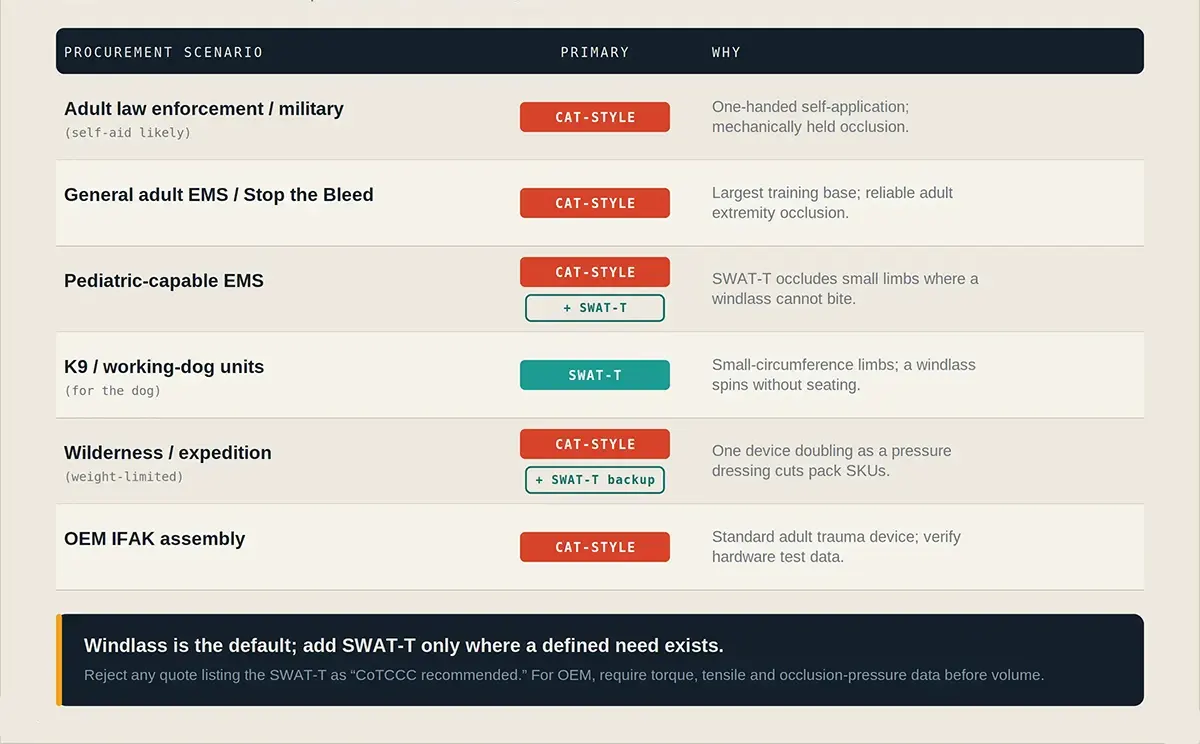
Patient population and self-aid requirement are the two variables that drive almost every call. Match the scenario, not the sticker price.
| Procurement scenario | Recommended primary | Why |
|---|---|---|
| Adult law enforcement / military (self-aid likely) | Windlass CAT-style | One-handed self-application; mechanically held occlusion |
| General adult EMS / Stop the Bleed | Windlass CAT-style | Largest training base; reliable adult extremity occlusion |
| Pediatric-capable EMS | Windlass primary + SWAT-T | SWAT-T occludes small limbs where a windlass cannot bite |
| K9 / working-dog units | SWAT-T (for the dog) | Small-circumference limbs; windlass spins without seating |
| Wilderness / expedition (weight-limited) | Windlass primary, SWAT-T as multi-use backup | One device doubling as pressure dressing cuts pack SKUs |
| OEM IFAK assembly | Windlass CAT-style default | Standard adult trauma device; verify hardware test data |
What to Put in Your Spec
- Spec a windlass CAT-style tourniquet as the primary adult extremity device; do not substitute a SWAT-T for it on cost grounds.
- Add SWAT-Ts only to kits with a defined need: pediatric-capable, K9, junctional reach, or weight-limited multi-use.
- Reject any quote or datasheet that lists the SWAT-T as “CoTCCC recommended”—it is not on the primary-device list.
- For any program where self-application is plausible, the windlass wins on one-handed use alone.
- When sourcing OEM, require windlass torque, band tensile, and occlusion-pressure test data before volume commitment.
Building or sourcing OEM trauma kits? Tell us the patient population and self-aid requirement, and we will spec the right windlass-to-wrap ratio. Request a bulk quote.
Related procurement comparisons: CAT vs RATS tourniquet (windlass vs a fully elastic ratcheting band) and CAT vs SOF-T tourniquet (two windlass devices compared head-to-head).
Frequently Asked Questions
Is the SWAT-T a direct replacement for a CAT-style tourniquet?
No. They are different classes of device. A windlass CAT-style tourniquet is the primary choice for adult extremity hemorrhage and one-handed self-application. The SWAT-T is an elastic wrap best used for small or pediatric limbs, K9s, high limb placement, and multi-purpose backup. Specifying one as a one-for-one swap for the other is the most common procurement error with these two products.
Is the SWAT-T CoTCCC recommended?
No. The SWAT-T is not on the CoTCCC Recommended Devices List for primary extremity hemorrhage control, which is made up of windlass and ratchet devices such as the CAT Gen 7, SOF-T Wide, SAM XT, and TX series. The SWAT-T is recognized as a useful supplementary device, particularly for pediatric limbs and pressure-dressing use, but it is not a recommended primary tourniquet.
Why does the SWAT-T work on children when windlass tourniquets sometimes fail?
A windlass needs a minimum limb circumference to generate compression; on very small limbs, it can spin without occluding. In Sweating the Little Things (Military Medicine, 2019), windlass devices failed to tighten on 1-year-old pediatric upper-extremity models while the SWAT-T achieved occlusion. The elastic wrap has no minimum-circumference floor, which is why pediatric-capable programs carry it.
For a mixed kit, what ratio of windlass to SWAT-T should we order?
Set the ratio by mission, not by a fixed formula. A common structure is one windlass CAT-style per responder as the standard primary, with SWAT-Ts added only to kits with a defined need, such as pediatric-capable units, K9 handlers, or weight-limited packs. Avoid issuing both as co-primary to the same person, since maintaining proficiency on two application methods raises hesitation risk under stress.
Can we source OEM SWAT-style and CAT-style devices for our own kit brand?
Yes. Qualified manufacturers produce both windlass CAT-equivalent and elastic-wrap devices for OEM trauma kits, typically 30 to 50 percent below branded pricing at volume. Require test documentation before committing: windlass torque and band tensile data for the windlass units and stretch tolerance plus material-aging data for the elastic units. Request a Certificate of Authenticity and a receiving-inspection protocol for every shipment.
Why We Wrote This
We supply windlass CAT-style and elastic-wrap devices for OEM trauma kits, so we meet the substitution trap at the spec stage—on a sourcing brief—before it becomes 1,200 of the wrong device on a loading dock. That is the vantage point this comparison is written from: the equipment and sourcing side, not the clinical-services side. The clinical findings here are cited to CoTCCC and peer-reviewed military medicine studies; the cost figures are framed as ranges from public sourcing experience, not promises—your numbers depend on configuration, certification scope, and freight. Reviewed by the Rusun TacMed Technical Supply Desk.
Disclaimer: This article is for educational and procurement reference only. Tourniquet selection and application training should be conducted under qualified medical or tactical instruction. This content does not constitute medical advice.
References
- Committee on Tactical Combat Casualty Care (CoTCCC), Recommended Devices and Adjuncts List, 2024.
- Stretch and Wrap Style Tourniquet Effectiveness With Minimal Training, Military Medicine, 177(11):1366, 2012.
- Sweating the Little Things: Tourniquet Application Efficacy in Two Models of Pediatric Limb Circumference, Military Medicine, 184(Suppl 1):361, 2019.
- TEMS Solutions / Safeguard Medical, SWAT-T Tourniquet Product Specifications and Instructions for Use, 2025.
- North American Rescue, CAT Gen 7 Product Specifications and Instructions for Use, 2025.
Disclaimer: This article is for educational and procurement reference only. Tourniquet selection and application training should be conducted under qualified medical or tactical instruction. This content does not constitute medical advice.


