
Kaolin Hemostatic Gauze — OEM Manufacturer with Published Comparison Data
We are a kaolin hemostatic gauze manufacturer in Yichun, Jiangxi. We make one thing well and we make it on lines that do nothing else.


Kaolin Hemostatic Gauze Built for Export Buyers, Not Retail Shelves
We are a kaolin hemostatic gauze manufacturer in Yichun, Jiangxi. We make one thing well and we make it on lines that do nothing else.
Most of what a buyer finds when searching for hemostatic gauze is written for someone buying a single packet. This page is written for whoever has to defend the purchase afterwards: the distributor answering a ministry tender, the kit assembler whose customer will ask what the certificate actually covers, the procurement officer who needs a document checklist before the shipment moves.
What we sell is a kaolin impregnated gauze in Z-fold and roll formats, sterile, non-exothermic, across ten registered widths. What we are asking you to evaluate is not the clay. Every kaolin hemostatic gauze uses the same clay. It is everything around it.
As a hemostatic gauze supplier working almost entirely on export programmes, we are used to being asked for the technical file before the price. That order suits us.

So this page publishes things a retail page never does. Our comparison data against the branded product, including the run where the two were tied. Our exact certificate numbers, so you can verify them without asking us. A plain statement of the certifications we do not hold. And the moment where we tell you to buy someone else's product instead.
Why Two Kaolin Hemostatic Gauzes at the Same Price Perform Differently

Every kaolin hemostatic gauze rests on the same physics. Kaolin — the combat gauze hemostatic agent in every current-generation product, branded or generic — is a negatively charged clay mineral. When blood contacts it, Factor XII changes conformation and activates. That opens the intrinsic pathway of the clotting cascade: Factor XI, IX, VIII, X, then prothrombin to thrombin. The clay is inert. It is not absorbed. It does not react chemically with tissue. Unlike the zeolite products that preceded it, it releases no heat.
That shared physics is exactly why the category is hard to buy. If every product activates the same pathway, what is left to compare?
Distributors usually answer with price, because price is the only number on the table. We think that is the wrong answer. The rest of this page is our argument for why.
The variables that actually differ are unglamorous. How much kaolin sits on each square metre of substrate. What that substrate is made of. Whether the impregnation holds under handling.

Kaolin loading.
More clay is not automatically better. Past a point the surplus sheds into the packaging and never reaches the wound. What matters is loading that survives folding, vacuum sealing, transport and one-handed deployment during wound packing.

Substrate.
Our 2024-generation gauze moved from a second-generation non-woven to a natural-fibre base. The reason is absorbency. Clay only works where blood reaches it, so a substrate that wicks faster puts more blood in contact with more kaolin in the first seconds. Those seconds are when a controlled bleed and an uncontrolled one diverge. The natural-fibre base is also softer and conforms better into an irregular cavity, which matters when the person packing the wound is doing it one-handed under stress.

Impregnation.
Even distribution with adhesion sufficient to resist shedding is the genuinely difficult part, and no datasheet in this category discloses it. It is where two dedicated lines earn their keep. Kaolin impregnation is not something we run between other jobs on shared equipment.
A gauze that sheds kaolin inside the packet delivers less clay than its label implies. A substrate that absorbs poorly keeps blood away from the clay it carries. Neither failure shows up in a product photograph.
What this hemostatic gauze dressing does not do. It is a packing dressing for compressible haemorrhage. It is not absorbable, so it must be removed before definitive surgical repair. It does not replace a tourniquet for arterial extremity bleeding. It does not seal a sucking chest wound. If your requirement is any of those, the right product is elsewhere in the kit.
Our Kaolin Hemostatic Gauze Lineup — Z-Fold, Roll and Ten Registered Widths
Three configurations cover almost every export programme we quote.
Z-fold hemostatic gauze, vacuum-sealed.
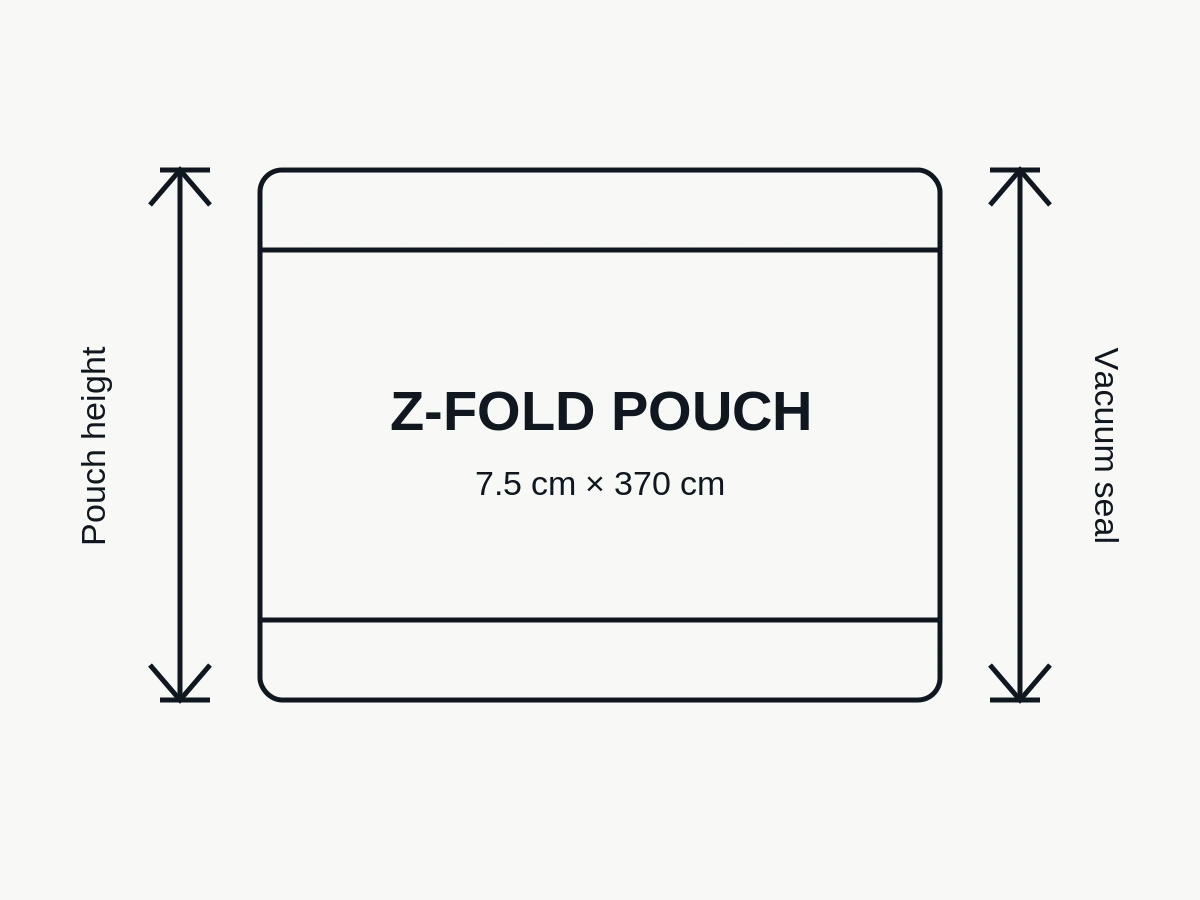
The tactical standard and our highest-volume line. The z fold gauze stack feeds out of the pouch in a continuous ribbon, which is what makes single-handed wound packing possible. Common export configuration is 7.5 cm × 370 cm. This is the format that goes into IFAKs, vehicle kits and ministry tender lots. Full dimensional table, pouch drawing and datasheet for this line sit on the Kaolin Z-Fold Hemostatic Gauze product page.
Roll format.
For buyers whose end users prefer a conventional roll, or whose kit layout will not take a flat pouch. Same kaolin loading and same substrate; the difference is deployment, not chemistry.
Width-matched variants.
Our national device registration covers ten widths from 2.5 cm to 10 cm and lengths from 4 cm to 5,000 cm. This is the part of the lineup that branded products do not offer. If your tender specifies a 5 cm dressing for paediatric or small-limb use, or a 10 cm width for torso packing, a generic kaolin impregnated gauze supplier is usually the only route to it. We have quoted programmes that exist purely because the specified width was not available from the branded line.

Non-sterile training stock.
Same substrate and same fold, without the sterile barrier and at a fraction of unit cost. Medics who train on a different material learn the wrong handling feel, so we run training lots on the same line as the sterile product rather than sourcing a lookalike.
Every configuration is a hemostatic combat gauze in the functional sense, sharing the same core: medical-grade kaolin activating Factor XII on contact, an X-ray detectable line woven through the gauze, a natural-fibre substrate with inherent antibacterial and bacteriostatic properties, radiation sterilisation to ISO 11137, and a vacuum-sealed foil pouch.
One consequence of that sterilisation choice is worth stating plainly, because buyers who have been burned on it will ask. We irradiate rather than use ethylene oxide. That removes the EO residual question entirely — there is no ISO 10993-7 residual limit to test against, because there is no residual — and it means each lot is released dosimetrically against a validated dose rather than on a biological indicator with an aeration hold. For a buyer whose customs or ministry file asks how the sterility of a specific lot was established, a dose record is a shorter conversation than an EO residual report.
Two things buyers routinely ask at this point. Whether the z fold gauze and the roll differ in kaolin loading: they do not, and the certificate of analysis for either format reports against the same specification. And whether a hemostatic gauze dressing at 10 cm width behaves differently from the 7.5 cm in practice: the wider dressing reaches haemostasis on broad torso wounds with fewer layers, but it wastes material on a limb, which is why most programmes carry two widths rather than one.
| Parameter | Range |
|---|---|
| Registered widths | 2.5 / 3 / 4 / 5 / 6 / 7 / 7.5 / 8 / 9 / 10 cm |
| Registered lengths | 4 cm to 5,000 cm |
| Common export configuration | 7.5 cm × 370 cm, Z-folded |
| Formats | Z-fold in vacuum-sealed pouch, or roll |
| Types | Type I, Type II |
| Active agent | Medical-grade kaolin, contact activation of Factor XII |
| Substrate | Natural fibre, inherent antibacterial and bacteriostatic properties |
| Radiographic detection | X-ray detectable line |
| Indication scope | Superficial wounds and deep tissue injury of head, face, limbs and torso |
| Thermal behaviour | Non-exothermic. Releases no heat. |
| Biological character | Inert, non-animal-derived, non-systemic. Not absorbable; remove before surgical repair. |
| Sterilisation | Radiation, validated to ISO 11137; dosimetric lot release |
| Operating and storage | −20 °C to 50 °C |

Selection Matrix — Matching Format and Width to Your Programme
Buyers rarely need help choosing kaolin over some other chemistry. They need help deciding which configuration to put in the tender, and how many of each.


| If your programme is | Choose | Why |
|---|---|---|
| Military or law-enforcement IFAK | 7.5 cm × 370 cm Z-fold | Single-handed deployment during wound packing; flat pouch fits the standard IFAK cavity |
| Ambulance and pre-hospital service | 7.5 cm Z-fold plus a 10 cm width | Crews pack torso wounds more often than limb wounds; the wider dressing reduces layering time |
| Paediatric or small-limb protocols | 2.5–5 cm widths | Narrower cavity, less wasted material per application |
| Kit assembly under your own brand | Z-fold, private-label pouch | Printed pouch, carton and leaflet in your language |
| Training and simulation stock | Non-sterile training configuration | Same handling feel at a fraction of unit cost; no sterile barrier to waste |
| Hospital pre-hospital supply | Roll format | Familiar handling for staff trained on conventional dressings |
A note on how to read this table. It is organised around the programme, not the wound, because the person choosing usually buys for a fleet of kits rather than a single casualty. If you are specifying for a mixed service — some ambulances, some tactical teams, some training — the answer is almost never one line item. It is a ratio, and the ratio is what we would rather quote.
Three practical notes from quoting these programmes.
First, most first-time buyers over-order the 7.5 cm width and under-order everything else, then come back within two quarters for the widths they skipped. The 7.5 cm is the format everyone has seen, so it becomes the default even where the casualty profile does not support it. If your service treats more torso trauma than limb trauma, the ratio should lean wider than instinct suggests.
Second, if training stock is in scope, order it in the same run as the sterile lot. The handling feel of a hemostatic trauma gauze is what medics learn on, and training on a different substrate teaches the wrong muscle memory. It also costs less to run both in one production window than to place a second order three months later.
Third, decide the format before the width. Z-fold and roll are not interchangeable in a kit layout, and switching format after the kit inserts are tooled is expensive. Buyers who lock format first and then tune widths across two ordering cycles end up with a cleaner programme than buyers who do the reverse.
If you are unsure which row you are in, send us the casualty profile and the kit count rather than a product code. We would rather quote the right mix and lose the initial order size than quote what was asked for and have the ratio corrected at your cost.
Head-to-Head Comparison: Our Kaolin Gauze vs QuikClot Combat Gauze
We ran three comparative tests on the 2024-generation product, benchmarked against the branded combat gauze dressing most tenders name by default. That is the same generation we currently ship.


In-vitro clotting comparison
Method: 4 mL of fresh rabbit blood applied to a single layer of hemostatic gauze, clotting assessed at five minutes.
| Dressing | Result at 5 minutes |
|---|---|
| Rusun 3rd generation | No blood dripping through the gauze. Container base clean. |
| Rusun 2nd generation | Blood droplets visible on gauze; unclotted blood at container base |
| QuikClot Combat Gauze | Blood droplets visible on gauze; unclotted blood at container base |
We include our own previous generation deliberately. It shows the same result as the competitor, which is a fair description of where our second generation actually sat.
Rabbit femoral artery transection
| Dressing | Time to haemostasis | Blood loss |
|---|---|---|
| Rusun kaolin gauze | 2 min 39 s | 8 g |
| QuikClot Combat Gauze | 4 min 07 s | 12 g |
| Third-party comparator | over 9 min 30 s | 32.1 g |
Swine femoral artery transection (n = 3 per group)
| Animal | Rusun kaolin gauze | QuikClot Combat Gauze |
|---|---|---|
| 1 | ≤ 180 s | 372 s |
| 2 | ≤ 180 s | 278 s |
| 3 | 271 s | 352 s |
| Re-bleed on limb flexion | None | None |
| Re-bleed on elevation | None | None |
| Re-bleed on stretcher transport | None | None |
| 24-hour survival | 3/3 | 3/3 |
How to read this honestly. Three animals per group is a small study. We did not run a statistical significance test, so we do not call the difference significant. That word has a specific meaning we have not earned.
Look at animal 3. Our 271 seconds and QuikClot's 278 seconds are effectively the same result. The separation comes from animals 1 and 2. The "≤ 180 s" entries are a censored value rather than a measured one, reflecting the observation interval in that protocol.
What the study supports is narrower than a marketing claim, and more useful. In this model, on this generation, our gauze was not the slower option. It held through all three re-bleed challenges: limb flexion and extension, elevation, and stretcher jolting. All six animals survived to 24 hours.
The full protocol covers species and strain, anaesthesia, the injury model, the observation schedule and the reason for the censoring. It sits in the study report with the procedure video. We send both on request rather than publishing selected frames.
One thing the table does not show, and which matters more than the seconds. Every animal in both groups survived, and neither product re-bled under any of the three challenges. On this model, at this severity, both products worked. The comparison is about margin, not about one product failing.
We publish the tied run on purpose. A distributor who later finds it in the report would trust nothing else on this page. That is a worse outcome for us than losing one comparison.
The Certification Premium — What the Price Gap Actually Buys
A branded kaolin combat gauze can retail at five to ten times the landed cost of a comparable generic. The manufacturing cost gap is nowhere near that wide. So what is the buyer paying for?
Three things. None of them is the formulation.
The CoTCCC recommendation.
The Committee on Tactical Combat Casualty Care names QuikClot Combat Gauze as its hemostatic dressing of choice for the US Department of Defense. That recommendation attaches to that product. It does not attach to ours, and no generic kaolin gauze can borrow it.
FDA 510(k) clearance.
A cleared device has been through premarket review. Our regulatory status is different, and we describe it precisely below.
Two decades of documented field use.
Accumulated case reports and after-action data have a value no test report substitutes for.
The Certification Premium is the price of those three documents. It is real value for the buyer who needs it. A defence ministry tender specifying CoTCCC-recommended products is not being irrational. It is buying a procurement defence.
A commercial distributor selling into civilian first-aid channels is in a different position. So is a government buyer outside NATO procurement frameworks. Both are frequently paying for a document their tender never asks them to produce.
Which of those you are decides where to buy:

| Your situation | Where to buy |
|---|---|
| US federal or NATO tender specifying CoTCCC-recommended hemostatics | Buy the branded product. We cannot meet this specification and we will say so at the enquiry stage, not after the order. |
| Regulated market requiring an EU MDR Notified Body certificate | Not us today. Our EU pathway is under review. We will not sell you a compliance claim we cannot evidence. |
| MENA, Southeast Asia or LATAM distribution requiring ISO 13485 manufacture and product test data | ✅ Our core market |
| Private-label or OEM programme for a kit assembler | ✅ Ten registered widths, Z-fold and roll |
| Training and simulation stock | ✅ Non-sterile training configurations |
The two rows where we send you elsewhere are the reason to believe the three where we do not.

Field Outcomes and Engineering Judgement from a Kaolin Hemostatic Gauze Supplier
We do not publish named customer case studies. Our buyers are distributors and government purchasers in markets where naming them would be unwelcome, and an unnamed testimonial with no numbers in it is worse than none. What we can publish is what we have learned making and shipping this product, which is more useful to you anyway.
Batch consistency is where generic kaolin gauze usually fails, and it is invisible at the sample stage.
A supplier can hand-select a good sample. What separates a sample from a programme is whether lot number 40 behaves like lot number 1. This is why kaolin impregnation runs on dedicated lines here rather than shared equipment, and why every lot ships with its own certificate of analysis rather than a certificate for the product family. When a buyer audits us, this is the record we open first.
The most common question we get after first shipment is not about performance. It is about paperwork.
Customs in several of our markets will hold a medical device consignment over a mismatch between the certificate scope and the commercial invoice description. We have learned to send the document checklist with the quotation rather than with the shipment, because the checklist is where a first-time importer discovers they need something their broker never mentioned.
Vacuum integrity is the failure mode buyers under-plan for.
A pouch that has lost vacuum should be treated as no longer sterile, and the cause is almost always handling in the destination warehouse, not manufacturing. Programmes that store stock in high-humidity or high-temperature conditions should build a stock rotation schedule around the labelled shelf life rather than assuming a fixed replacement interval.
On what we will commit to in writing.
Lot-level certificates of analysis with every shipment. Sample before first order. Replacement of non-conforming goods. A factory audit, in person or by video walkthrough, before you place a programme order rather than after a problem. None of that requires you to trust us; all of it is checkable.
— Rusun TacMed Technical Supply Desk
Certifications, and What Each One Actually Means
This section probably differs from what you are used to reading on a Chinese supplier page, so we will be explicit about the distinction that matters most. A quality-system certificate is not a product approval. A registration is not a clearance.

ISO 13485:2016 and EN ISO 13485:2016.
Certificate 172692.240327, issued by UL Solutions under UKAS accreditation, valid to 26 March 2027. The registered scope names hemostatic gauze explicitly, alongside nasopharyngeal airways, first-aid kits, chest seals, needle decompression kits and tourniquets. Certificate status is verifiable in UL's public directory of registered firms. Please check it rather than take our word for it. This certifies how we manufacture. It does not certify any individual lot.

FDA Establishment Registration and Device Listing.
Registration number 3023809973, owner/operator 10085490, listing D475951 under product code NAB, with our role recorded as manufacturer and foreign exporter. Registration and listing are administrative filings. They do not constitute FDA clearance or approval, and describing them as such would be misleading. Under 21 CFR 807.39, any representation creating an impression of official approval on the basis of registration constitutes misbranding. We hold registration and listing. We do not hold 510(k) clearance for this device.
National device registration (NMPA).
Covers the type and dimensional range in the specification table above.
Third-party testing.
Biocompatibility and performance testing has been performed by independent laboratories. Reports accompany the technical file.
Recognition.
The underlying technology formed part of a project awarded a second-class National Science and Technology Progress Award in 2017 for emergency-care equipment development. It is covered by two granted invention patents.
What we do not claim.
We do not hold FDA 510(k) clearance. We do not hold an EU MDR Notified Body certificate for this device. We are not listed by CoTCCC. Any supplier telling you that a certificate of EU representative notification is the same as CE conformity certification is either confused or counting on you being confused.
Four documents constitute actual evidence for a lot, as opposed to evidence about our factory. The ISO 13485 certificate covers the system. The lot certificate of analysis covers the batch. The dosimetric release record covers that batch's irradiation dose. The biocompatibility report covers the material. Ask any supplier for all four. The answer is informative.
Why Source from Rusun — Inside Our Kaolin Hemostatic Gauze Factory
Two thousand square metres of cleanroom, and two production lines dedicated to kaolin haemostatic dressings. They are not shared with other product families, which is how impregnation consistency holds batch to batch. Monthly capacity is 100,000 pieces.


The technology has a longer history than our export presence suggests. Project initiation in 2012. Laboratory validation by 2014. National award recognition in 2017. First volume export production in 2022. Second generation in 2023. Current generation in 2024. We ship the 2024 generation, and it is the generation the comparative testing above was performed on.
Being a hemostatic gauze factory in China rather than a trading company changes what we can answer. When a buyer asks why lot behaviour shifted between orders, we can look at the impregnation record for that shift rather than forward the question to a supplier we do not control. When a tender requires a document we have not issued before, we can produce it from the production record instead of explaining why it is unavailable.
Lot traceability, production records and export documentation are open to buyer audit. We would rather you did one before the first programme order than after a problem.
It also changes what we cannot do. We do not hold finished stock in destination markets, so a buyer needing next-week delivery in-country is better served by a regional distributor who already has our product landed. We will tell you that rather than quote a lead time we cannot hold.
It also sets what we can commit to on scale. A hundred thousand pieces a month is a real ceiling, not a brochure number, and we would rather tell a buyer their programme needs staging across two months than accept a schedule we would miss.
Procurement — MOQ, Lead Time, Wholesale Tiers and OEM Supply
Hemostatic gauze is quoted per configuration rather than from a list. Width, length, format, packaging language and sterilisation batch size all move the number.
| Our label | Private label / OEM | |
|---|---|---|
| Minimum order quantity | 1,000 pcs | 5,000 pcs |
| Lead time, stock configuration | within 7 days | not applicable |
| Lead time, made to order | 30 days | 30 days |
| Monthly production capacity | 100,000 pcs | shared with our own label |
Two things worth reading off that table. A first order of 1,000 pieces is a genuine trial quantity, not a barrier disguised as one. And at 100,000 pieces a month, a 20,000-piece programme occupies about a fifth of a month's line time, which is the number you need when planning a tender delivery schedule rather than a one-off purchase.
On pricing. We quote on enquiry rather than publishing a price list. The reason is not coyness. Width, length, sterilisation batch size, packaging language and destination documentation move landed cost enough that a published figure would be wrong for most buyers, and a wrong number is worse than no number. Send the configuration and quantity and you get a real one.
What we need from you to quote accurately:
- Target quantity, and whether it is a single order or a scheduled programme
- Width, length and format (Z-fold or roll)
- Destination port and market
- Whether the product sells under our label or yours
- Which documents your customs and tender process require
What you get back within 24 hours: a tiered quotation showing the quantity breaks, the lead time for each tier split between stock and made-to-order, the sample policy, and a document checklist for your destination market.
Wholesale and distribution terms.
Wholesale tiers are built around programme volume rather than single-order size, so a distributor committing to a scheduled quarterly draw is priced differently from an equivalent one-off. Tell us the annual shape and we will quote the shape, not the first tranche.
OEM and private label.
Printed pouch, carton and instruction leaflet in your language, your brand, your artwork. The private-label minimum is 5,000 pieces against 1,000 for our own label, because printed packaging carries its own tooling and print-run economics.
Export documentation
routinely provided: certificate of analysis per lot, certificate of origin, commercial invoice and packing list, and the HS classification for your customs broker. Additional legalisation or embassy attestation can be arranged where a destination market requires it.
Risk terms. Samples before first order. Lot-level certificates of analysis with every shipment. Non-conforming goods replaced. We do not ask a first-time buyer to take manufacturing quality on faith. That is what the sample and the CoA are for.
Frequently Asked Questions
Is this the same as QuikClot Combat Gauze?
It uses the same active mineral, kaolin, working by contact activation of Factor XII, on our own substrate and impregnation process. It is not the same product. It does not carry the CoTCCC recommendation and it is not FDA 510(k) cleared. Our comparative animal data is above. The differences that matter to your tender are documentary, not chemical. Anyone comparing one combat gauze hemostatic dressing against another should be reading the impregnation and substrate specification, not the name on the pouch.
Why is the branded product so much more expensive?
A CoTCCC listing, a 510(k) clearance and twenty years of documented field use cost money to obtain and maintain, and that cost is in the price. If your market requires those documents, the premium buys something real. If it does not, you are paying for a document your tender never asks you to produce.
Do I actually need hemostatic gauze, or is plain gauze enough?
For compressible haemorrhage that direct pressure and plain packing control, plain gauze is enough and cheaper. Kaolin gauze earns its cost where bleeding does not respond to plain packing: deep junctional wounds, coagulopathic patients, extended evacuation times. Many kits legitimately carry both. What holds that pressure once hands are needed elsewhere is a separate line item — the pressure bandage, which secures the packed wound rather than replacing the packing. For the evidence behind that split, see our hemostatic dressing vs gauze comparison.
Does it burn or heat the wound?
No. Kaolin is non-exothermic. Thermal injury was a problem with the earlier zeolite generation of haemostatic agents, and it is the main reason the category moved to kaolin.
Does it dissolve, or does it need to be removed?
It must be removed. Kaolin gauze is not absorbable. Remove it before definitive surgical repair, and tell the surgical team what was packed and when.
What sizes can you actually make?
Ten registered widths from 2.5 cm to 10 cm, lengths from 4 cm to 5,000 cm, in Z-fold or roll. The common export configuration is 7.5 cm × 370 cm Z-folded. The registration range is considerably wider, which is often why buyers come to us.
What is the shelf life, and how is it stored?
The labelled shelf life is printed on each lot. Storage is −20 °C to 50 °C in the sealed vacuum pouch. The stability data supporting the labelled period is part of the technical file sent with a quotation. A pouch that has lost vacuum should be treated as no longer sterile.
Can you supply the rest of a trauma kit?
Yes. Our ISO 13485 scope covers tourniquets, chest seals, nasopharyngeal airways, needle decompression kits and first-aid kits alongside hemostatic gauze. For a kit assembler that is usually simpler than managing five suppliers.


Related


Ready to specify your order?
Tell us the quantity, the width and format, the destination port, and which documents your market requires. You will have a tiered quotation, a lead-time split between stock and made-to-order, and a document checklist within 24 hours.

About This Page
Written by the Rusun TacMed technical supply desk. Comparative animal-study figures come from our own commissioned testing on the 2024-generation product. The full protocol is available with the technical file. Certificate numbers are stated so they can be independently verified. Where we do not hold a certification, we say so rather than omit it.
Last updated: 2026-07-28
References & Sources
- Effectiveness of kaolin-impregnated hemostatic gauze in preperitoneal pelvic packing· PLOS One
- QuikClot Combat Gauze for Hemorrhage Control· Prehospital and Disaster Medicine, Cambridge University Press
- Misbranding by reference to establishment registration or to registration number· 21 CFR 807.39, Electronic Code of Federal Regulations


