
Emergency Trauma Bandages / Israeli Bandage
4″, 6″ and 8″, Built and Registered in Jiangxi
Every page on this search result calls its Israeli bandage combat proven, sterile and one-handed. All true, and none of it separates one supplier from another. What follows is the paperwork and the materials, missing from all nine competitor pages we read.


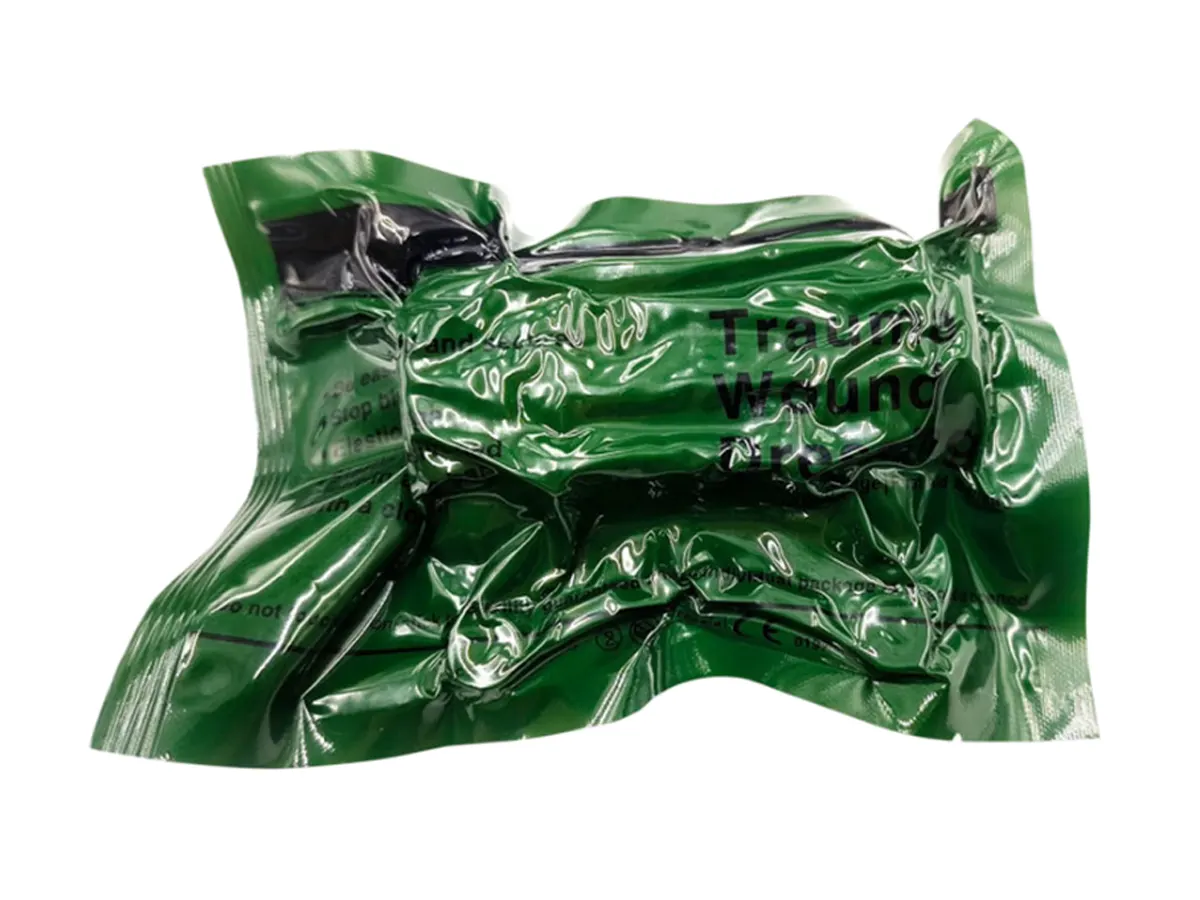

Three supplied widths for quotation, all individually vacuum packed
Device class, wound dressings — on registration and licence alike
Shelf life, vacuum sealed individually — our figure, not a standard
Latex yarn in the elastic wrap — this product is not latex-free
Israeli Bandage Manufacturer, Not a Reseller
We build this product in Jiangxi and ship it under our own registration. That is a narrower claim than most pages in this category make, and it changes what this one is able to tell you.
A reseller writes about the device: how it works, who invented it, why it belongs in a kit. All of that is already well covered, and the AI summary at the top of your search results has covered it again before you got here. A factory has different facts available, most of them boring: which document covers which device class, what the elastic is made of, what happens when your market asks for paperwork we do not hold.
Those are the facts this page carries. If you want to know how to apply an Israeli bandage one-handed, this is the wrong page and we have not written that section. If you are deciding whether to put a Chinese factory on a vendor list, or whether the units on a tender line can be sourced here rather than from a distributor at three times the unit cost, keep reading.
One clarification before the rest of this page, because it saves everyone time. If you are buying a handful of units for a personal kit, none of this matters and a retail listing will serve you better. This page is written for someone placing a repeat order, whether you are a distributor, a kit assembler, or an institutional buyer working to a tender document. If you are looking for an Israeli bandage supplier rather than a shopping cart, everything below assumes that reader.
The Factory's Note — Why We Publish the Disqualifying Facts
We would rather lose a sale at the specification stage than at the inspection stage. Several things below are written with that in mind, including one that disqualifies us outright for some buyers.
The elastic wrap contains latex. We supply 4″, 6″ and 8″ formats, while abdominal dressings are handled as a separate sourcing question. We hold CE, FDA listing, ISO 13485 and domestic registration documents for buyer review. Each document is stated in full further down rather than left for a sample shipment to reveal.
A page that only lists what a supplier can do forces you to discover the rest at your own cost.
Who Makes the Israeli Bandage, and Why That Question Misleads You
Ask Google who makes the Israeli bandage and the AI summary answers with a lineage: First Care Products invented it in Israel, Safeguard Medical distributes it globally after acquiring PerSys in 2019. That answer is correct. It is also the reason most procurement conversations about this product start in the wrong place. We read nine of the pages currently ranking for this term before writing — retailers, a distributor, an encyclopedia entry, a brand site, and two Chinese factories. Not one of them published a registration number or a licence scope. Here is the census in full, so you can check the claim rather than take it. Every row comes from the supplier's own live page, read in August 2026.
| Supplier | Base | Public product line | تحديد المواقع | Certification wording on page | Registration no. / licence scope |
|---|---|---|---|---|---|
| Safeguard Medical | US | The Emergency Bandage® 4″/6″/8″, WoundStop | Brand owner | none stated | not published |
| Israeli First Aid | إسرائيل | 4″/6″/8″ abdominal, white variants | Retailer shipping from Israel | Present, no numbers | not published |
| أساسيات الإنقاذ | US | 4″/6″/8″/abdominal | Tactical retail | Present, no numbers | not published |
| My Medic | US | 4″/6″ | Retail kit brand | none stated | not published |
| Chinook Medical Gear | US | 4″ (the page read; a 6″ is listed elsewhere on the site) | Expedition and tactical retail | Present, no numbers | not published |
| MedResQ / Anping Guardian | China, Hebei | 5 SKUs, AZ-EB-01–05 | OEM/ODM factory | “FDA-approved… ISO CE certificate”, no numbers | not published |
| Rhino Rescue | الصين | Same product families as ours; SKU list not recorded | OEM/ODM factory, leads with production area and export-country counts | not recorded in full | not published |
| Rusun TacMed (this page) | China, Jiangxi | HC-004 4″, HC-005 6″ | Registered manufacturer | Class II registration + production licence, numbers below | published |
The census maps what each supplier publishes, not what each supplier holds. Several of these companies certainly hold documents they have chosen not to put on a web page, and a retailer has no reason to publish a manufacturer's certificate at all. What the table shows is narrower and still useful: if you are trying to verify a bandage supply chain from a browser, seven of the eight rows give you nothing to verify.
Seven of the nine pages we read are represented above. The eighth is an encyclopedia entry rather than a supplier. The ninth is a US B2B distributor whose page we read but did not record cell by cell, so it is left out rather than filled in from memory. Two further suppliers appeared in the same search results but blocked automated reading, and are also left out rather than guessed at: Bound Tree Medical and Medline, both US B2B distributors.
Tell us which credential your market actually checks, and we will say whether we can put a number on it or not.
Ask What We Can Put a Number OnThe design dates from the early 1990s. Bernard Bar-Natan, an Israeli military medic, was issued bandages stamped 1942 and decided the “grab a stone to apply pressure” instruction deserved better engineering. The patent has long since expired, the construction is public, and the device is now built in several countries. So the honest answer to who makes it is: quite a lot of people, and the ancestry of the design tells you nothing about the consignment arriving at your port.
What does tell you something is narrower. Does the factory hold a registration certificate for this product, in this device class? Is that class inside the factory's production licence scope? The two are not interchangeable. A registration certificate says the product is approved for sale; a licence scope says the plant is approved to build that category at all. A supplier can hold one without the other, and plenty do.
Both of the Chinese factories in that set are worth a moment, because they are the closest thing to a direct comparison we have. Both sell most of the same product families we do. Both lead with production area and export country counts. Neither publishes a certificate number for the bandage line. That is the gap this page is written into: not a claim to be better made, but a claim to be more checkable.
Procurement Note — Certification Has Stopped Working as a Filter
The closest anyone came to a credential was a sentence promising the goods are “FDA-approved” and hold an “ISO CE certificate,” with no number, no issuing body and no stated coverage attached. That phrasing survives because nobody checks it. So the question changes: not how close are you to the original manufacturer, because we are not close at all, but which category credentials can you put a number on. That question we can answer, and on the evidence of those nine pages, most of the search results cannot.
What the Nine Ranking Pages Published
Nine pages currently ranking for this term, read and counted in August 2026: retailers, a distributor, an encyclopedia entry, a brand site, two Chinese factories.
Not one page published a registration certificate number or a device class.
Source: 9 SERP pages, read Aug 2026No page stated what the elastic is made of, and none mentioned latex in either direction.
Source: 9 SERP pages, read Aug 2026Certification wording appeared on fewer than half the pages, and never with a number attached. We did not record the exact count, so the hatched bar shows the upper bound rather than a measurement.
Source: 9 SERP pages, read Aug 2026Only two pages stated a shelf life at all. We could find no authoritative standard for this category.
Source: 9 SERP pages, read Aug 2026What We Can Actually Show You
Two documents, both with numbers you can quote back at us. We call the pair the Category-Credential Ledger, because the useful part is not the numbers on their own but the line-by-line account of what each one does and does not cover.
| السطر | وثيقة | Number | ما الذي يثبته ذلك | ما لا يثبته ذلك |
|---|---|---|---|---|
| 01 | Medical device registration certificate | 赣械注准20252140215 | This product, as an emergency trauma bandage in class 14-11 wound dressings, is approved for sale; valid to 23 September 2030 | That the goods in your container match the registered product. That is what incoming inspection is for |
| 02 | رخصة الإنتاج | 赣药监械生产许20240671 | The plant is licensed to build class 14-11, wound dressings | Nothing about class 14-01 puncture devices, which our other lines sit in and this licence does not cover |
| 03 | ISO 13485 certificate | held | Quality management system certificate available for buyer review | Not a substitute for product registration, CE review, or shipment inspection |
| 04 | التعقيم | Irradiation · STERILE | R | The method used and the pack marking | Dosimetric release. We hold no separate release records and quote no kGy figure |
| 05 | رئيس مجلس الإدارة | held | شهادة CE | CE certificate available for buyer review during quotation |
The ledger is a record of coverage, not a warranty of quality. A registration number tells you a regulatory file exists and has an expiry date you can see; it does not tell you the last production run was good. Read it as the floor, not the ceiling.
How to use these two numbers
A registration certificate number is checkable against the issuing provincial authority's database, and a production licence number is checkable the same way. What they prove is that a real regulatory file exists behind the product name and that the assessment has an expiry date you can see. A supplier who cannot produce either number is asking you to take the chain on trust.
That is also why we publish the classification code rather than just the certificate number. Class 14-11 is wound dressings. If a certificate's class covers general medical consumables or a different device family, the certificate is real and the coverage is wrong. Ask for the class, not just the number.
Line 02 is the one suppliers most often gloss over. Holding a licence is not the same as holding a licence that covers what you are buying. We know this from our own catalog: our chest decompression needle line sits in class 14-01, puncture devices, which our production licence does not cover, so that product page cites our quality system scope instead. Bandages are the one category where both documents line up. We would rather tell you which of our own lines are and are not covered than let you assume uniformity across a catalog. You can read more about the factory in Jiangxi if the company background matters to your vendor file.
Now the parts we cannot show you, listed here rather than buried
We are not the original manufacturer and hold no licence or authorization from the Israeli producers. We do not use their registered product name anywhere on this site.
Our ISO 13485 certificate exists, but its scope covers nasopharyngeal airways, first aid kits, chest seals, decompression needle kits, tourniquets and hemostatic gauze. Bandages are not named in it, so we do not offer it as this product's credential. If a supplier cites a quality system certificate for a category the certificate does not name, that is worth a question.
We sterilize by irradiation and pack accordingly, so the packaging carries the STERILE | R mark. We hold no separate dosimetric release records, so we will not quote a kGy figure or cite a sterilization validation standard. Sterilization method is a fact we can state; sterilization validation is a document we do not have.
We hold a CE certificate for this product. Whether CE documentation and Chinese registration support your import route still depends on the destination market and buyer file requirements. Tell us the destination country and we will confirm what supporting documentation we can issue before you commit to anything.


What's Actually Inside
This is the section none of the nine pages had. Across all of them, not one published a material composition, and not one mentioned latex in either direction.
Latex is what makes the wrap behave the way an Israeli bandage has to behave: stretch, hold tension for hours, recover rather than creep. That is a mechanical property, not a marketing one. It is also an allergen, and in some procurement environments it is disqualifying.
We are aware that publishing this costs us something. Latex-free is a claim several buyers filter on, and we cannot make it. But the alternative, printing “100% cotton” on a product page, which is what this page said before today, is worse than unhelpful. A hundred percent cotton has no elastic recovery and could not produce an Israeli compression bandage at all. That line was wrong, it has been removed, and the composition below replaces it.
None of that makes our bandage better than anyone else's. It makes it specifiable, which is a different and more useful property at tender stage. If you are drafting a tender line, those four standard numbers are the ones to copy, and any supplier bidding on that line should be able to answer against them.
Read This Before You Specify
The elastic wrap contains 14% latex yarn. This product is not latex-free.
If your hospital system, your ministry tender or your own kit specification requires latex-free components, this product does not qualify and you should not order it. Say so in your inquiry and we will tell you immediately rather than after a sample shipment.
If you are supplying environments where latex exposure is acceptable but needs declaring, the composition alongside is the declaration; confirm the wording your market requires and we will match it on the label.
Material Composition, By Component
Four components, four published specifications. The dressing pad carries two textile standards because it is two layers: FZ/T 64005-2011 governs the non-woven face that has to lift away without pulling the clot with it, and YY/T 0330-2015 governs the medical absorbent cotton behind it. A buyer writing an incoming inspection protocol can test against both rather than against a supplier's adjective.
Elastic bandage
- Polyester low-stretch yarn40%
- Polyester staple fiber46%
- Latex yarn14%
Dressing pad
- Non-woven fabricFZ/T 64005-2011
- Medical absorbent cottonYY/T 0330-2015
Hook-and-loop closure
- Nylon (polyamide)GB/T 20218-2006
Fixation bar
- Injection-molded PEYY/T 0114-2008
Specifications: 4 Inch, 6 Inch and 8 Inch
We build three widths. The 4″ is the general-purpose size for arms, lower legs and head wounds; the 6″ covers thighs, torso and larger wounds; the 8″ is for wider dressing coverage. All are supplied as 6-meter unrolled bandages in individually sterile-wrapped vacuum packs.

4 Inch — HC-004

6 Inch — HC-005

8 Inch
For wider coverage needs, the 8″ version gives additional dressing width while keeping the same pressure-bar construction. If your kit specification calls for an abdominal dressing, confirm that as a separate product line before quotation.
| المعلمة | 4 inch | 6 inch |
|---|---|---|
| Product code | HC-004 | HC-005 |
| Width | 4″ / approx. 10 cm | 6″ / approx. 15 cm |
| البناء | Non-adherent sterile pad, elastic wrap, pressure bar, closure bar | Same |
| التعقيم | Irradiation · STERILE | R | Irradiation · STERILE | R |
| مدة الصلاحية | 5 سنوات | 5 سنوات |
| التعبئة والتغليف | Individually sterile-wrapped, vacuum sealed | Individually sterile-wrapped, vacuum sealed |
| Pad dimensions | On request | On request |
| الطول بعد الفرد | 6 meters | 6 meters |
One honest gap remains in that table. Pad dimensions are available on the specification sheet rather than printed here. The unrolled length is 6 meters for both widths; width, pad size and wrap length together determine which wound location a bandage can cover.
The convention across this category is three sizes: the الطب العسكري literature cited by the encyclopedia entry names 4, 6 and 8 inches. Our range covers the first two. In practice the 4″ is what goes into individual kits by volume, because it handles the injuries a single responder is most likely to meet and takes less pocket space. The 6″ tends to be specified one or two per kit, or bought in bulk by services that see torso trauma. If you are building a mixed kit line, the ratio is a question for your own casualty data, not for us.
Packaging affects freight cost rather than clinical outcome. Each unit is vacuum sealed individually, which is what allows the five-year shelf life and what keeps the pack flat. At container scale, flat packs change how many units fit a carton and how many cartons fit a pallet, which is the number that moves your landed cost. The five-year shelf life is our figure for this product, not an industry standard: our ضمادة ضغط الضمادة H, a different construction using an H-shaped cinch rather than a pressure bar, carries three years and four size options up to 150 mm × 4500 mm. Treat any supplier quoting a “standard” shelf life for this category as someone you should ask for a source.
Eight Names, One Product
Buyers keep asking search engines what else this thing is called, and the question shows up in the “people also ask” box on most search results for this category. It is a fair question, because the naming is a mess and the mess has procurement consequences. Below is the Eight-Name Crosswalk: eight ways to write the same purchase line, and which two of them quietly name somebody's brand.
| Name | Status |
|---|---|
| ضمادة إسرائيلية | Generic, most common |
| Israeli emergency bandage / emergency care bandage | Generic |
| Israeli pressure bandage / Israeli compression bandage | Generic, describes the mechanism |
| Israeli battle dressing | Generic, military usage |
| Israeli combat dressing | Generic, military usage |
| Israeli dressing / Israeli trauma bandage | Generic |
| Trauma dressing / trauma bandage / trauma dressings | Generic, broader category |
| Emergency trauma dressing (ETD) | In practice a North American Rescue product line |
| The Emergency Bandage® | Registered trademark, Safeguard Medical |
The crosswalk maps vocabulary, not equivalence. Two suppliers can both answer to “trauma dressing” and ship different constructions, which is why the right-hand column of a tender line has to carry the width and the pressure bar rather than the name alone.
The generic rows are not interchangeable either. “Pressure bandage” and “compression bandage” describe the mechanism and are used by clinical and training audiences. “Battle dressing” and “combat dressing” are military-trade vocabulary, common in defense procurement documents and rare in hospital ones. “Trauma dressing” is broadest and covers products that are not Israeli bandages at all, including plain absorbent pads with no pressure bar. If you write “trauma dressings” into a purchase order, specify the pressure bar or you may receive something simpler, and the difference will not show up until the cartons are opened. The same applies to “Israeli dressing” and “Israeli trauma bandage”: both are understood across the trade, but neither commits a supplier to a pressure bar.
Our own search data makes the point from the other direction. The terms that bring buyers to this page most reliably are china israeli combat dressing و china israeli battle dressing — military-trade phrasing rather than retail phrasing. Until today this page did not contain the words “combat dressing” or “battle dressing” anywhere. Buyers were finding us despite the page, not because of it. That is a small piece of evidence about who is actually looking for a Chinese manufacturer in this category, and it is not the retail shopper the rest of these search results are written for.
Where Tenders Go Wrong
Write “ETD” into a specification document and you have, without meaning to, narrowed the field to one manufacturer's product line. Search that term and five of the first seven results are that company's product. The same applies to the trademarked name.
If what you want is the device rather than a specific brand's version of it, use a generic descriptor and specify the width and construction instead — and if the line is still open, compare it against the other three pressure dressings on the three constraints a tender actually checks. A line reading “emergency bandage, 6 inch, with pressure bar and closure bar, individually sterile packed” is brand-neutral and quotable by every supplier who can build it. “ETD, 6 inch” is neither.
That is the whole payoff of the Eight-Name Crosswalk: pick a generic row, then specify the construction the generic row does not guarantee.
Send the tender line you are drafting and we will tell you which rows we can quote against and which we cannot.
Send Us Your Tender LineWhere a Pressure Bandage Sits in Bleeding Control
An Israeli bandage is not a tourniquet, and the two are not alternatives. This comes up often enough in search queries that it is worth one clear table — including the column most selection matrices leave out.
| Situation | Tool | Where this row does not apply |
|---|---|---|
| Arterial bleeding from a limb | Tourniquet, high and tight | Junctional and torso bleeding, where no tourniquet fits |
| Junctional wound (groin, armpit, neck) | Hemostatic gauze, packed | Shallow tracks the gauze cannot reach the base of |
| Irregular or shallow wound tracks | Hemostatic agent | Deep cavities needing mechanical packing |
| Compressible open wound needing sustained direct pressure | Pressure bandage — this product | Non-compressible torso bleeding, where no external pressure reaches the source |
| Mass casualty | Tourniquet first, then packing | Single-casualty care, where the sequence is set by the wound rather than by triage |
The right-hand column is the part most selection tables leave out. A row that never states its own boundary invites the wrong purchase.
Typical use cases include trauma kits, field rescue, pre-hospital emergency care and emergency wound dressing where direct pressure and secure wrapping are needed.
The integrated pressure applicator earns this device its row. Wrap, feed the elastic through the pressure bar, reverse direction, and the bar concentrates force onto the pad rather than distributing it around the limb. The closure bar then locks the end without a knot, supporting rapid single-person application in field or pre-hospital settings. The non-adherent pad matters for a different reason entirely: it lifts off without tearing the clot open when the dressing is changed downstream.
In a kit, these are parallel items rather than substitutes. An IFAK carrying a tourniquet still needs a pressure bandage, because most wounds are not limb arterial bleeds. If you are specifying a full bleeding control kit rather than a single line item, our مجموعة أدوات التحكم في النزف page covers how the components combine, and the kaolin hemostatic gauze و عصابة ضاغطة من نوع CAT pages cover the other two branches. We have deliberately kept application technique off this page: it is a training subject, well covered in video elsewhere, and a procurement page is the wrong place for it.
The tourniquet-versus-bandage question specifically is a sequence question rather than a selection question, and we take it apart with the three TCCC conversion criteria in الضمادة الإسرائيلية مقابل العاصبة.
A Gap in Our Own Catalog
There is a gap in our own catalog worth pointing at. Our hemorrhage control kit page carries a selection matrix of four rows: tourniquet, hemostatic gauze, hemostatic agent, and a combined approach for mass casualty. The pressure bandage row was missing, even though the FAQ on that same page named pressure bandages as one of three essential components. That was our inconsistency, not a competitor's; the table alongside is the version we corrected it to, and the kit page now carries the row.
Why it matters for a buyer rather than for us: kits get specified from matrices like that one. If the matrix omits a category, the category gets omitted from the kit, and the omission is discovered by a medic rather than by a purchaser. Most bleeding that a first responder meets is not limb arterial bleeding amenable to a tourniquet, which is precisely why the pressure bandage line exists in every serious kit standard even when it is missing from a supplier's own comparison table.
Inside the Bandage Line
Floor area is a number we have verified. Monthly output is not, so we do not print one — ask for current lead time when you inquire and you will get the figure that applies to the week you are ordering in. The images below cover the assembly, sealing, inspection and packing steps on this line.
Product walkthrough
Israeli Bandage Structure and Pack Presentation
Watch the 4 inch / 6 inch format, 6-meter unrolled bandage, pressure bar, elastic wrap and sterile pack presentation before you review the production steps below.


Who This Suits, and Who It Does Not
Buying direct from a factory is right for some buyers and wrong for others. Rather than claim we serve everyone, here is which of the four is you.
Distributors
Repeat volume is where buying at this level pays. The savings compound across a bill of materials, and the paperwork only has to be validated once rather than per shipment. Private label runs from label-only through to a dedicated SKU built to your drawing.
Quantity bands1–500 · 500–2,000 · 2,000–10,000 · 10,000+
Private labelFour levels; MOQ quoted against your actual volume
What to sendWidth, band, destination market, label level

Kit Assemblers
If you are building IFAKs or vehicle kits, the 4″ is what goes in by volume and the 6″ is usually specified one or two per kit. The ratio is a question for your own casualty data, not for us. Note that we cannot fill an abdominal line — you will need a second source for that.
Typical mix4″ as the default, 6″ specified per kit
التعبئةVacuum sealed, low-cube — carton quantity supplied with the quote
Gap to plan aroundNo 8″, no abdominal version

Institutional & Tender Buyers
Institutional buyers working to a tender document usually need the documentation section above more than the price. Our registration is Chinese and does not transfer automatically to MENA, Southeast Asian or Latin American markets, so the practical question is which supporting documents we can issue: certificates of free sale, technical files, test reports, letters of authorization. We confirm specifics per market rather than promise a generic package.
Tell us firstDestination market, and whether latex-free is mandatory
Specify withWidth + pressure bar + closure bar + individually sterile packed
Avoid in the spec“ETD” and the trademarked name — both narrow the field to one supplier

One-Off Buyers and Small Clinics
You are generally better served by a regional distributor, who will hold stock, ship next day, and absorb the import formalities that would otherwise land on you for a single carton. We would rather say this here than take an order that costs you more in freight and paperwork than the goods are worth.
Better routeA regional distributor holding local stock
لماذاImport formalities do not scale down to one carton
Still useful hereThe census and the naming crosswalk, when you compare listings
Procurement Guide — Order Bands, Private Label, Lead Time & Documents
Israeli bandage bulk pricing is quoted against the band you expect to run, not the band you order first. Below is what actually moves the number, and what we will confirm in writing rather than approximate on a web page.
Order sizes
Our inquiry form offers sample and trial units, then bands at 1–500, 500–2,000, 2,000–10,000 and 10,000+. Sampling before a first production order is normal and we encourage it, since the composition above is worth verifying by hand rather than by PDF.
Private label
Four levels, in ascending order of lead time: label only; label and retail packaging; label, packaging and a color change on the wrap; and a dedicated SKU built to your drawing. Minimum quantities differ by level and we quote them against your actual volume rather than publish a number that will be wrong for most readers. Buyers rarely search for this before they arrive on a product page, but it is usually the second question in the email.
Lead time and capacity
The bandage line runs in our 4,000 m² cleanroom facility. We are not going to print a monthly output figure here, because a floor-area number and a capacity number are different claims and we only have the first one verified. Ask for current lead time and you will get the figure that applies to the week you are ordering in.
Packing and shipping
Carton quantity, carton dimensions and container loading are supplied with the quotation. Several competitors publish case quantities on their product pages, with cases of 50, 100, 150 and 200 all common in this category, and we will give you ours in writing rather than approximate it here.
Export and registration documents
Tell us the destination market. Our registration is Chinese and does not transfer automatically, so the practical question is which supporting documents we can issue to help you register or import: certificates of free sale, technical files, test reports, letters of authorization. What we can provide varies by market.
Get a Detailed Quotation
Send the width, the quantity band, the destination market and whether latex-free is a hard requirement. We answer the last one before anything else, because it determines whether the product fits your requirement.
Traceability — What We Are Not Claiming
Batch coding and certificate-of-analysis arrangements are confirmed per order rather than promised in advance. We are deliberately not making a blanket traceability claim on this page. The reason is specific: we have made that mistake before on another product line, where a page argued for per-lot documentation the operation was not actually set up to deliver.
Ask the question in your inquiry and you will get a straight answer about this line rather than a policy statement.
What to Put in Your Inquiry
- Width required: 4″, 6″, or both
- Quantity band, and whether you want samples first
- Private label level, if any
- سوق الاستهداف
- Documents you need for import or registration
- Whether your market or specification requires latex-free — this decides immediately whether we can supply you at all
Run the same two columns from the Supplier Census against every quote you collect: what does this supplier publish about certification, and does that publication carry a number. It takes a minute per supplier and it will separate your shortlist faster than the unit price will.
Two Things You Can Take With You
Neither of these needs a reply from us. Copy them, use them against every supplier on your shortlist including us.
RFQ Checklist — Copy Into Your Inquiry
Six lines. Send these and you get a usable quotation on the first reply rather than the third.
Brand-Neutral Tender Line — Copy Into Your Spec
Quotable by every supplier who can build the device, and it does not accidentally narrow your field to one manufacturer's product line.
الأسئلة الشائعة
Yes. The elastic wrap contains 14% latex yarn, alongside 40% polyester low-stretch yarn and 46% polyester staple fiber. This product is not latex-free. If your market or your specification requires latex-free components, this product does not qualify, so please say so in your inquiry and we can save time on both sides. For settings where latex is acceptable but must be declared, the composition above is the declaration.
At least eight names describe the same device: Israeli bandage, emergency bandage, Israeli emergency bandage, Israeli pressure or compression bandage, battle dressing, combat dressing, trauma dressing and emergency trauma dressing. Two of those are effectively proprietary. ETD is in practice a North American Rescue product line, and The Emergency Bandage® is a Safeguard Medical trademark. Using either in a tender can narrow the supplier field more than intended.
Five years for the Israeli and emergency bandage, three years for our H bandage compression dressing, marked per product code. These are our figures for our products. If you need a different shelf-life requirement, please ask us to confirm against the batch record.
No, and they are not substitutes. A tourniquet occludes blood flow in a limb; a pressure bandage applies sustained direct pressure to a compressible wound; hemostatic gauze packs junctional wounds a tourniquet cannot reach. A properly specified kit carries all three.
Yes, with the number: 赣械注准20252140215, registered as an emergency trauma bandage in device class 14-11, wound dressings, valid to 23 September 2030. The Category-Credential Ledger above sets out what that number covers and, just as usefully, what it does not. Our production licence 赣药监械生产许20240671 covers the same class. What we do not claim: any relationship with the original Israeli manufacturer or separate dosimetric release records. We hold CE, FDA listing, ISO 13485 and domestic registration documents and can provide certificate scans for buyer review during quotation.
We supply 4″, 6″ and 8″ Israeli bandage formats. If your specification requires an abdominal dressing, treat that as a separate product line and confirm it during quotation.
If your question is not above, it is probably a specification or a document question. Those we answer with a number or not at all.
Ask a Question We Have Not AnsweredRequest a Quotation
Tell us the width, the quantity band, the destination market, and whether latex-free is a hard requirement. We will answer the last one before anything else, because it determines whether the product fits your requirement.
If your requirement is still taking shape, send what you have. A destination country and an approximate annual quantity are enough for us to say whether this is a line we can serve properly, and confirm the fit early if it is not.
References & Data Sources
- Emergency Bandage, Wikipedia — device history, citing الطب العسكري for the three-size convention.
- FZ/T 64005-2011 — non-woven fabric, dressing pad face layer.
- YY/T 0330-2015 — medical absorbent cotton, dressing pad.
- GB/T 20218-2006 — nylon hook-and-loop closure.
- YY/T 0114-2008 — medical polyethylene, fixation bar.
- شهادة التسجيل 赣械注准20252140215 and production licence 赣药监械生产许20240671 — issuing provincial authority, checkable by number.
- Supplier census: nine pages ranking for this term, read August 2026; two further suppliers were excluded because automated reading was blocked.
Statement of openness
Figures for our own products come from our registration file and production records. The census records what each supplier published on its own live page in August 2026, not what that supplier holds. It is a snapshot of published information, and one row is marked where we did not record a cell rather than filling it in. Where a document or product variant needs confirmation, this page says so directly: certificate scans are available for buyer review, dosimetric release records are not quoted here, and abdominal dressings should be confirmed as a separate product line. We hold a CE certificate for this product and can provide it during quotation.


