
فهرست مطالب
نکات کلیدی
- Do chest seals expire? Yes. Makers set an expiration date, and 27 of the 31 chest seal records pulled from FDA's device database for this article say the label carries one.
- The date covers seals kept the way the label says. A hot trunk or a folded seal can fall outside it.
- Labels differ: SAM and HALO print 6 years, while the HyFin pages checked on North American Rescue's site don't publish a figure.
- A PubMed search turned up no published test of expired chest seals, so duty kits get replaced at the date and old stock goes to training.
Chest Seal Expiry — Quick Reference
|
سوال |
What the sources say |
|---|---|
|
Is there a printed expiry date? |
Yes on 27 of the 31 chest seal records pulled from FDA's database for this article; when printed, written year-month-day under FDA labeling rules |
|
How long is the labeled shelf life? |
SAM and HALO: 6 years; HyFin: not on the maker pages checked |
|
Maker-stated temperatures |
HALO: −30 to 140 °F; FoxSeal: adhesion stated at −18 °C and +55 °C |
|
Short heat and cold exposure |
About 17 hours at 71.5 °C or −19.5 °C: four of five seals held; Bolin scored lower |
|
Folding |
HALO and Beacon: maker says fine; FoxSeal: maker warns folded dressings leak |
|
Past the date |
None found in a PubMed search (October 2026); replace duty stock, train with the old |
Each row is an FDA rule, a maker's own statement, a single study or our literature search, so check the label of the seal you actually stock. Sources: FDA labeling rules (21 CFR 801.18), FDA's AccessGUDID database, maker pages captured 15 October 2026, Arnaud et al. 2016.
Do chest seals expire? What the date on the pouch means
Do chest seals expire? Yes. Most chest seals are sold with a printed expiration date, and once it passes, the maker no longer vouches for that seal. The date on a chest seal pouch marks the end of the period the maker has tested, for seals kept the way the label says. It's a tested claim with conditions attached, and it reads quite differently from the cliff some people picture.
That's also how the U.S. regulator frames it. FDA's guidance on device shelf life defines the expiration date as the end of shelf life, after which a percentage of devices may no longer function as intended. Note the "percentage" (FDA, 1991). The guidance, written by FDA's device center, talks about a share of devices, some of which may no longer work as intended after the date. It doesn't say every seal fails at midnight, and it doesn't say they're all fine. The same guidance asks makers to print the expiration date where people will see it, so stock gets rotated. In other words, the date exists for the people who manage inventory. It's a logistics tool as much as a safety one. For stock, that means two habits: rotate by the printed date, and keep seals within the storage range on their label.
So why do people argue about it? Type "expired chest seals" into Google and you'll get forum threads and kit-maintenance posts among the results. Some posters bin a seal the day its date passes. Others call the date paperwork: it's plastic and glue, it'll be fine for years. That side has no evidence either: we found no published study that compares expired chest seals with in-date ones. Both camps skip the part that matters for anyone holding stock, which is what the date is based on and what can void it early.
Why does a sealed pouch carry a date at all? Because the parts inside it change. The hydrogel that grips skin, the liner, the vent and the foil pouch all age, and the two risks the developers of one vented seal test for, adhesion failure and vent failure, are the ones the date is there to catch. The label's storage range exists because temperature, humidity and light set the pace of that change. Pouch damage ends the claim early too. So three things, not one, decide whether the date still applies: the calendar, the storage history and the pouch itself. The next section walks through what ages and how the date is tested.
New to chest seals? Start with our explainer on what a chest seal is and how it is applied. Here we stick to "do chest seals expire?" and what the date means for the stock on your shelves.
What the expiration date is based on
Makers don't pick the date out of the air. They age samples and test them, and the date marks how far that testing reaches. And every one of those tests assumes the seal was kept the way its label says.
Testing often starts with accelerated aging. Samples are kept somewhere warmer than normal, so a short spell in the heat stands in for a much longer time on a shelf. The scope section of ASTM F1980-21 lists what that shortcut can prove and what it can't. It covers sterile barrier systems and medical devices. ASTM F1980 lets accelerated data back an expiration date while real-time aging results are still coming in, and it leaves out the extreme climate swings a package can hit in shipping and handling. The same scope section says accelerated data shouldn't be used to set the storage conditions on a label. FDA's 1991 guidance makes the same point from the other side: samples aged in real time have to confirm what the fast tests suggested.
What actually ages inside a sealed chest seal? Inside the sealed pouch, the hydrogel adhesive, the liner, the vent and the pouch seal all age, and the developers of one vented seal name adhesion failure and vent failure as the two main risks when a seal is applied. That last part comes from a team that developed a newer vented dressing and tested it for exactly those two things (Hoggarth et al., 2020). Their paper is about one design, written by the people who built it, so we use it only for the two failure modes.
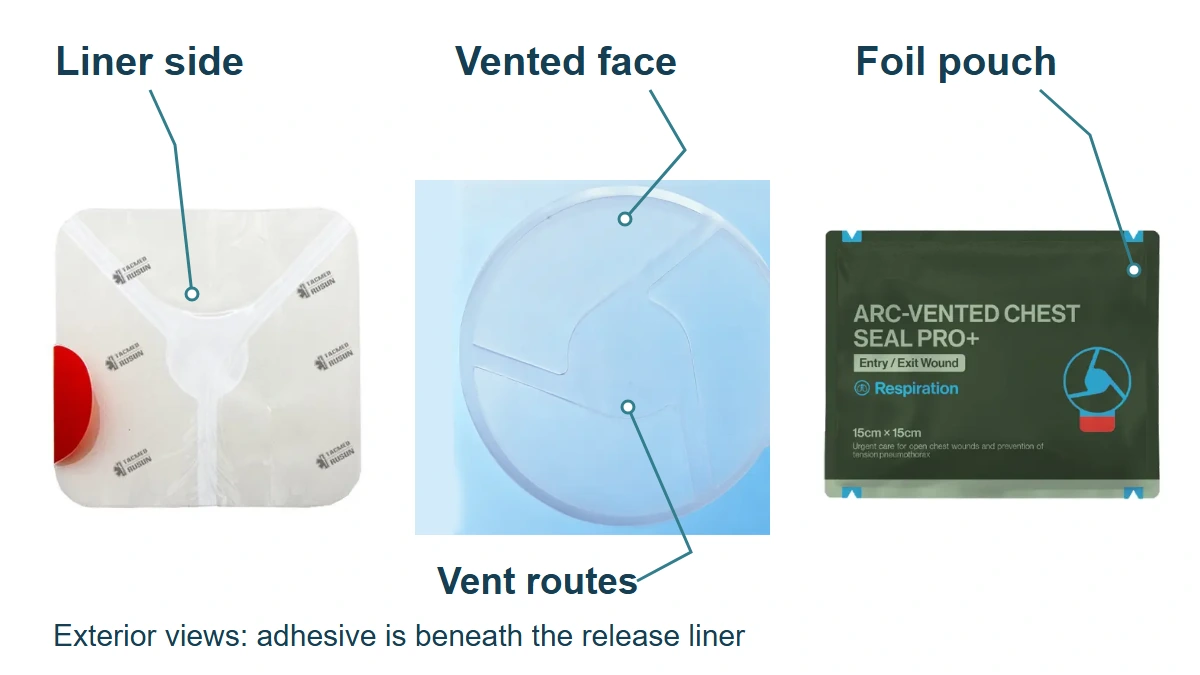
Picture a box of seals sitting in a supply room. The hydrogel is the gel that grabs skin, often wet, hairy or bloody skin, and when it weakens you see an edge peel up. The liner has to peel off cleanly in a hurry. The vent, whether a valve or flat channels, has to stay open and flexible, and you cannot see whether it still does. And the foil pouch keeps moisture and grime out. A liner that will not release is the other failure you meet on opening; a vent that has stiffened is the one you don't meet, because it looks the same either way. We'd expect the adhesive edge to be the first failure you can see in a warm supply room; after a season of vehicle heat, check first that the seal comes out of its pouch and off its liner cleanly: a kit-maintenance video of an expired pack warns that the gel can melt and stick inside the pouch, and shows some of it staying on the liner. FDA lists storage temperature, humidity and light among the conditions that can affect a device's safety or performance, and for seals sold sterile the pouch is also the sterile barrier, which FDA's guidance ties mainly to package and seal integrity. Packaging integrity matters for non-sterile seals too, so a torn or punctured pouch changes the picture before any date does. Check pouches when kits are opened, not only when the date comes up.
How much do we know about chest seals specifically? Less than you'd hope. The only systematic review of chest seal performance we found looked at six quantitative studies published between 1990 and 2020 and called the evidence on individual devices limited (Paquette et al., 2021). Its question was adherence and tension prevention, not storage, and the one storage test we found, Arnaud 2016, ran about 17 hours.
We call this the 3-Condition Date Test. A seal is inside what the maker tested only when all three hold:
- The printed date hasn't passed.
- The seal has been stored within its label range.
- The pouch is intact.
The test does not measure how well a seal will stick; it only tells you whether you're still inside what the maker tested. Take away any one of those three and you're relying on luck. Room temperature in a supply room is the easy case; the harder cases come up in the sections on heat and folding.
How long chest seals last: what each maker's page says
Each maker runs its own tests and prints its own number, so there is no industry figure to assume: of the five seals in the table below, only SAM's and TacMed's HALO carry a published figure, and both say 6 years. The figure on the pouch of the seal you stock is the only one that counts for that seal. Assume one generic number and you misprice stock both ways: a 6-year SAM or HALO written off at five is discarded a year early, while a seal whose maker publishes no figure, assumed to last five, may already be past the date printed on its own pouch. Where numbers do differ, there is a reason: hydrogel recipes, backing films, scrims and pouches differ by maker, and so do the aging programs behind them. TacMed, for one, says it adds a non-woven scrim to the HALO gel to stop it migrating in heat, and a design choice like that gets tested on its own schedule, not on an industry one.
SAM Medical and TacMed Solutions both print a 6-year shelf life, SAM for its chest seal and TacMed for HALO, and the HyFin pages on North American Rescue's site, as checked for this article, give no shelf life. SAM puts "6-year shelf life" on its صفحه چسب سینه. TacMed lists the same figure for the HALO chest seal, so if you've wondered "do HALO chest seals expire?", the maker's answer is yes, after 6 years. The three North American Rescue HyFin product pages checked on 15 October 2026, including the HyFin Vent and the non-vented HyFin, carry no shelf-life figure.
That leaves a gap for a seal plenty of buyers ask about. Searches like "hyfin chest seal shelf life" and "what is the shelf life of hyfin chest seals" don't get a published answer on the maker pages we checked. Ask the supplier for the printed expiry date and lot of the stock they're offering before you order. "How long do HyFin Vent chest seals last?" then has a concrete answer: until the date on that batch.
Temperature statements vary too. TacMed Solutions gives HALO a temperature range of −30 to 140 °F. Safeguard Medical says FoxSeal's adhesion holds at −18 °C (0 °F) and +55 °C (131 °F) (Safeguard Medical, FoxSeal). For the Russell seal, Safeguard's page says it showed reliable adhesion and valve function after storage in extreme temperatures, without giving a range.
Shelf life and temperature statements, maker by maker
|
Seal (maker or seller) |
Shelf life on the maker's page |
Temperature statement |
|---|---|---|
|
SAM Chest Seal (SAM Medical) |
6 years |
No range; says it "sticks relentlessly – through extreme heat or cold" |
|
HALO (TacMed Solutions) |
6 years |
−30 to 140 °F |
|
FoxSeal (Safeguard Medical) |
Not stated on the page |
Adhesion held at −18 °C and +55 °C |
|
Russell (Safeguard Medical) |
Not stated on the page |
"Reliable adhesion … following storage in extreme temperatures" |
|
HyFin (North American Rescue) |
Not stated on the pages |
ذکر نشده است |
These figures come from each maker's own product page, captured on 15 October 2026; each is the maker's own statement, not an independent test result we could check. It isn't a ranking, and "not stated" means the maker's page didn't say, which is different from the product having no limit.
You may have seen "3 to 5 years" quoted as a rule of thumb. It doesn't match any maker's label captured for this page, so treat it with caution.
Is the date at least reliably printed? Mostly: FDA's device database records whether a label carries an expiration date, and most chest seal records we looked up say it does; the section on reading the pouch, below, walks through that lookup. So the flag answers one question: is there a date on the label? For how long the seal lasts, you're back to the maker's label.
Heat, cold and the car
The date assumes label storage, and accelerated-aging guidance isn't built to simulate extreme climates either. So a seal that has spent a summer in a patrol car's trunk hotter than its label allows is outside what the date covers, even if the calendar says it's fine.
Is there any published data on heat and cold? We found one study. Arnaud's Navy and Army team held five vented seals at −19.5 °C or 71.5 °C for about 17 hours, and Russell, Fast Breathe, HyFin and SAM still stuck while Bolin scored lower. The researchers, from the Naval Medical Research Center, the U.S. Army Institute of Surgical Research (USAISR) and the U.S. Army Medical Materiel Agency (USAMMA), first screened eight vented seals on swine skin smeared with field-type grime, kept the five with the best scores, then stored them hot or cold and peeled and pulled them again (Arnaud et al., 2016). These were the versions of each seal on sale when the study was run, so the result may not carry over to a redesigned product. Arnaud's team saw no significant difference in adherence among the five at room temperature. Bolin was already breaching more often there. After the hot and cold storage it scored lower, and it came loose and breached the most.
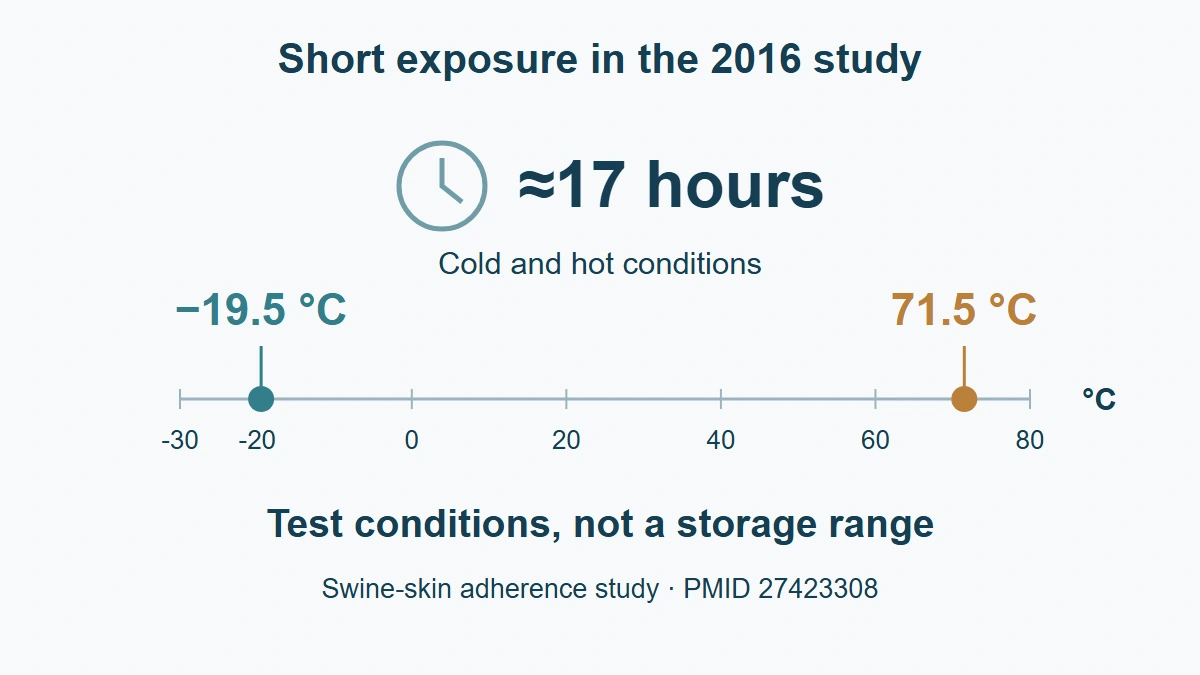
In Fahrenheit, 71.5 °C is about 161 °F and −19.5 °C is about −3 °F. That is hotter than HALO's 140 °F ceiling and FoxSeal's 131 °F adhesion claim, so the study pushed harder on temperature than the one label range we found, HALO's, allows, but only for a night. The catch is the duration. That test covered about one night of extreme storage, and a vehicle kit can stay in the same trunk through a whole summer. The study tells you four of five seals survived a single hard night. It doesn't tell you what months of heat cycling do to a hydrogel adhesive, and we found no published test that does. The kit-maintenance videos and forum posts that rank for this question add two field observations, not data: seals left through summers in a vehicle still stuck but peeled off more easily than new ones, and a forum poster who had deployed found some hot, expired, much-carried seals unusable and called it a gamble.
It's worth noticing who ran it. One of the author groups was the Army Medical Materiel Agency, which suggests storage was a supply question for the team as well as a clinical one.
Why would heat matter to a sealed seal? The pouch stops dirt and damp. Heat is another matter: the gel inside ends up at whatever temperature the trunk reaches. TacMed Solutions says it adds a non-woven scrim to the HALO hydrogel to keep the gel from migrating in high heat, which tells you at least one maker designs around exactly this. Their stated ranges and the one published study we found are the best guide you've got.
Common Mistake
Reading "in date" as "good to go" for a vehicle kit. The date assumes the label's storage range, and a trunk in July or a roof box in January can sit outside it for weeks. Log where each vehicle trauma kit lives, and treat stock that has sat outside its label range as failing the 3-Condition Date Test, even when the calendar says otherwise.
So where should seals live? Within the storage range on the label or instructions of the product you stock. TacMed's HALO page lists −30 to 140 °F and doesn't say if that's for storage or for use. Safeguard says FoxSeal's adhesion holds at 0 °F and 131 °F; that's Safeguard's own test claim, so don't read it as a storage range. No label we captured says how long a seal may sit at the top of its range, and none mentions humidity or light, though FDA lists both as shelf-life variables. Where a maker gives one range without saying storage or use, we'd treat it as the storage limit, the stricter reading.
For vehicle kits, write three cases into the SOP, and keep a batch in a cooler supply room as backup for all of them. A kit with a temperature logger that shows no reading outside the label range is still inside what the date covers and can run to its printed date. A kit with a logged excursion outside the range is pulled now, and its seals go to training. A kit with no record either way rides on a shorter fixed cycle, for example after each hot season or every 12 months, whichever comes first; the seals that come off that cycle go through the open-one check described in the section on using a seal past its date, and if the sample passes they move to shelf stock and are issued first, ahead of seals that never left the supply room.
Can you fold a chest seal?
Can you fold chest seals to fit a small pouch? It depends on whose seal it is, because the makers disagree.
TacMed Solutions says HALO keeps working when folded or crushed, and Safeguard Medical says FoxSeal's smaller size avoids leaks from dressings stored folded. TacMed goes further for its Beacon seal: function and integrity, it says, are preserved when folded or rolled (TacMed Solutions, Beacon). Safeguard's FoxSeal page points the other way: its compact size fits an IFAK "without creasing or folding".
North American Rescue made the HyFin Vent Compact's packaging about 25% smaller than the standard HyFin Vent's, so you don't have to fold it to fit a kit. That's how the maker's HyFin Vent Compact page describes it, and it's a product built around the folding problem.
Why does a crease matter to a hydrogel seal in particular? The likely reason is that the gel is what holds the seal to skin, and a fold line is where it can thin, lift or split, which would be the leak Safeguard's FoxSeal page warns about. Before anyone folds a seal into a small pouch, we'd want four answers: what its maker says about folding, how much bigger the seal is than the pouch, how long it will sit folded, and how hot or cold that pouch gets while it does. The maker's statement is the one that settles it.
If space in an individual first aid kit (IFAK) is the issue, a HyFin Vent Compact chest seal or another compact format solves it without asking the adhesive to survive a crease.
Four seals, three makers, three different answers on folding
|
Seal (maker or seller) |
What the maker says about folding |
|---|---|
|
HALO (TacMed Solutions) |
Retains effectiveness when folded or crushed |
|
Beacon (TacMed Solutions) |
Function and integrity preserved when folded or rolled |
|
FoxSeal (Safeguard Medical) |
Compact size, so no creasing or folding; folded dressings can leak |
|
HyFin Vent Compact (North American Rescue) |
Packaging about 25% smaller, so it doesn't need folding |
These statements come from the makers' product pages, captured 15 October 2026. We found no independent test of folded storage for any chest seal, so the maker's own statement is the only guidance we found, and two makers say opposite things.
So, can you fold a chest seal? If its maker says folding is fine, it's within what the maker claims. If the maker warns against it, or says nothing, the question people type, "safe to fold chest seal for storage?", has no answer you can assume. Buy a compact seal sized for the pouch instead. When you write the kit spec, name either the fold statement you're relying on or the compact format.
Using a chest seal past its date
This section covers what is known about seals past their date and what to do with that stock; whether an expired seal should ever go on a casualty is a protocol question, and the end of the section says so rather than answering it. Are chest seals still good after expiration date? We found no published study that tests expired chest seals against in-date ones, so there is no published basis for saying how a given expired seal will perform. We searched PubMed in October 2026 for chest seal storage, temperature, shelf life and expiration studies and read every title. The storage work we found stops at Arnaud's 17-hour test.
The guidelines don't settle it either, as the TCCC Guidelines of 1 May 2026 show. The 2026 TCCC guidelines call for a vented chest seal on open or sucking chest wounds and say nothing about how chest seals are stored or about expired seals. Our overview of the Tactical Combat Casualty Care (TCCC) guidelines explains where chest seals sit in that system.
That leaves FDA's definition as the most solid footing. After the date, a percentage of devices may no longer work as intended. You can't tell from the outside which seals in the box those are. The videos and forum threads that rank for this question don't change that. The two YouTube videos peel one brand's seals by hand, in date in one and past its date in the other, and watch them stick to a mannequin or a cardboard box; the threads trade experience and opinion. Neither tests the vent or puts expired and in-date seals side by side, so they can't answer the question. For a sucking chest wound (an open pneumothorax) and the risk of tension pneumothorax behind it, that uncertainty is the whole problem.
What can go wrong with an old seal doesn't show until the pouch opens, and part of it not even then. As the expired-pack video mentioned earlier warns, the gel can melt and stick inside the pouch. A seal stuck in its pouch, or gel that comes away with the liner when you peel it, is the failure you can see. The vent is the one you can't: a valve or channel that has stiffened could look fine until air needs to leave the chest. Adhesion failure and vent failure are the two risks the developers of one vented seal name, which is why "it still feels sticky" is a partial check at best.
Here's the rule we'd suggest. Replace duty seals at the printed date, and move expired or damaged ones to training. Pull them earlier when something has already gone wrong: a torn or puffy pouch, a seal that's been stored outside its label range, or a kit that came back from a deployment where it sat hotter than its label range. Expired supplies make good practice stock; mark the training bin "training only" so pulled seals don't drift back into duty kits. Trainees get to open a real pouch, peel a real liner and place a real seal without spending duty stock.
Say an audit turns up a twin pack three months past its date in a duty kit. It comes out of the kit that day, its lot and date go into the log, and it goes to the training bin, and so does every other pouch from that lot still in service, because they share the date. The open-one check belongs to a different case: a lot still inside its date whose storage history you doubt but with no logged excursion outside its label range; a known excursion pulls the lot without a sample. Open one. If the liner releases cleanly and the gel is tacky, that is an adhesion check, which is all you can do by eye, and the vent you cannot test, so keep the lot only until its date and rotate it ahead of shelf stock; if the sample fails, the lot comes out. Then the reorder goes in with the remaining-life terms from the stocking section below.
A kit owner's version of the question is: what if my HyFin chest seals expire? The answer is the same as for any brand: they come out of duty kits and go into the training bin.
Whether an expired seal should go on a casualty when nothing else is available is a different question. That's for your protocol, your medical director and the maker's instructions, and this page doesn't answer it. If a seal isn't usable at all, our guide to improvised occlusive dressings covers what responders reach for instead.
Reading the pouch: lot, expiry and the UDI
You can't rotate stock by date if nobody can read or record the date. The label is built to help, and the date is not a sticker someone chose to add: under the UDI system it usually sits in the device's production identifier, the half of the identifier that changes lot by lot, while the device identifier names the product itself. That split is what makes a recall, a whole-lot check or a date-sorted issue list possible.
Under FDA's UDI rule, when the label's identifier includes the expiration date, the date sits in the production identifier, printed as year, month and day. The barcode, and the text printed with it, carry the unique device identifier. Depending on the label, its production identifier also holds the lot or batch number, the manufacture date or a serial number (21 CFR 830.3). Not every chest seal's identifier has a production part: some of the records we looked up list none, and then the barcode names only the product. Another rule, 21 CFR 801.18, puts the year first: the pouch shows 2031-05-01, where US habit would write 05/01/31. That makes dates sortable and harder to misread.
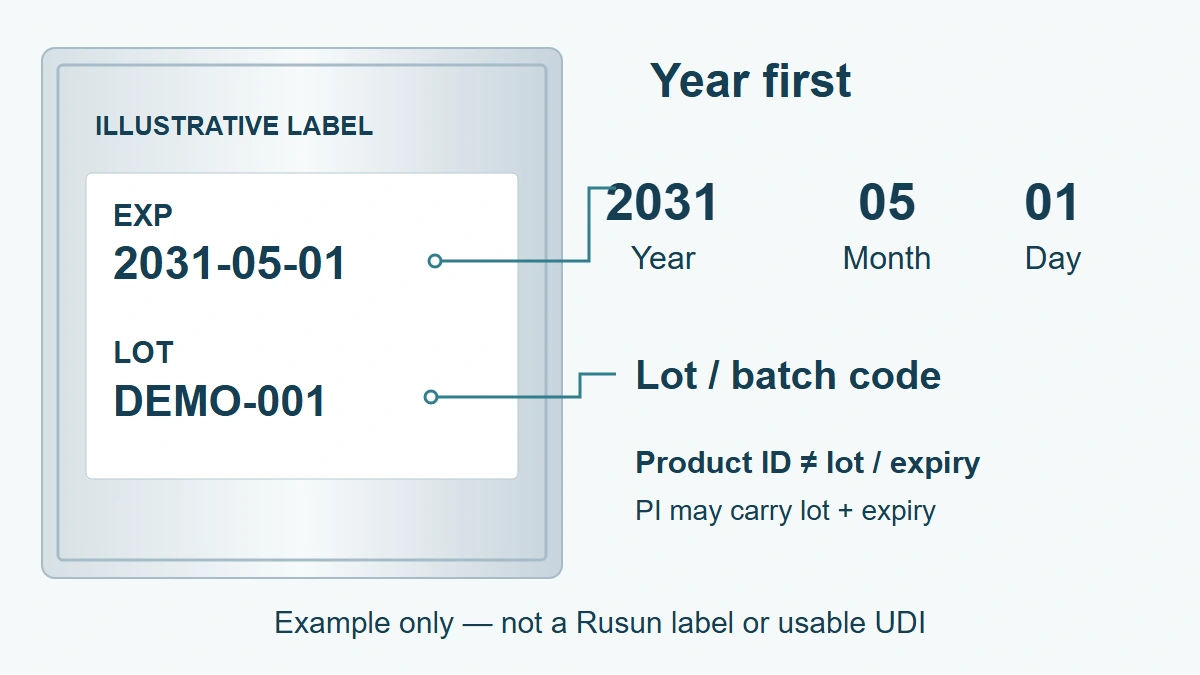
FDA's AccessGUDID database lets you look up whether a product's label is registered as carrying an expiration date and a lot number. Of the 31 chest seal records we looked up on 15 October 2026, 27 say it does; an H&H Bolin record, a Bound Tree Bolin kit, an early FoxSeal record and one Rhino Rescue record don't. There's no shelf-life field in a GUDID record. There is one for storage conditions, but on these records it's blank, so for both you go back to the maker's label and instructions.
What should the check at receiving look like?
- Find the date on every pouch. Year first, then month, then day. Two dates printed? Write down the expiry (use-by) date; the other one is usually when the seal was made.
- No expiry date on the pouch? Ask the supplier for the lot's expiry in writing before you accept it.
- Write down the lot next to the date, per carton if not per pouch.
- Pouch sealed flat? No tears, pinholes or bulges?
- Does the oldest date in this delivery leave you enough time before your next rotation?
- Same check at every kit audit, with a note of where the kit has been stored.
A pouch past its date, or a torn or bulging pack, fails the 3-Condition Date Test and goes to training or back to the supplier, whatever the paperwork says; a pouch with no printed expiry date is not a failure in itself, it is the case where you get the lot's expiry from the supplier in writing before accepting it, and the delivery goes back if they can't give one. A delivery that is too short-dated is a different problem, a supplier term, and the stocking section below handles it.
A spreadsheet with kit ID, lot and date is often enough. You can also scan the barcode. Either way, the goal is a list sorted by date, so the next seals to expire are the next ones issued.
Stocking rules: what to put in the order and how to rotate stock
A chest seal order needs five lines beyond price: the labeled shelf life, a minimum remaining life on delivery, lot and expiry on every pouch, the format, and separate duty and training quantities. Buying on price alone can leave you with stock that's already part-way through its life. One outdoor retailer even lists a "HyFin Vent Chest Seal Twin Pack, Expired" among the results for "do chest seals expire". Phrases like "1 year expiration date hyfin chest seal twin pack" turn up in keyword tools too, which suggests short-dated stock is out there.
Where does that life go? It starts draining at the maker's lot date and keeps going on a distributor's shelf and on the way to you, so a pack that sat for two years at a wholesaler shows up with a third of a six-year life gone before anyone logs it in. You can measure remaining life on the day the cartons arrive, so it goes into the order as a term the supplier has to meet; by the next audit the stock is already on your shelves.
Write a minimum remaining shelf life into the order, and stock arrives with most of its life still ahead of it. If a delivery falls short, you refuse it or have it re-invoiced on the training line; that's the whole point of the term. The lines on the order, that one first:
- How much shelf life do you need left on delivery? Tell the supplier, as a number.
- The labeled shelf life of the exact product you're buying, and its storage range, in writing.
- Where will the kits be stored, and do you need a compact format? Say so, and nobody ends up folding a seal whose label doesn't allow it.
- Every pouch printed with its lot and expiry, year-month-day, so one lot can be sampled or pulled without emptying every carton.
- Duty seals and training seals on separate lines, each with its own lot and expiry recorded.
- Still deciding on a vented or non-vented chest seal? Settle that first; our comparison covers the buying lines for each.
Once the stock is in, the rule is simple. Rotate stock first-expiring-first-out, which is why FDA asks makers to print the date where people can see it. Hand out the in-date seals with the nearest date first. One kind of stock jumps that queue: a lot with a doubtful storage history that passed the open-one check goes ahead of in-date seals that expire sooner, and only until its own date. Let the earliest date in stock decide when the next order goes in. If you're a distributor with stock held for several customers, the same rule should run across the whole warehouse.
Take a distributor tender for 500 twin packs. The lines read: product and format (vented, full-size or compact); labeled shelf life as the maker states it; minimum remaining shelf life on delivery, say five of six years for a 6-year product; lot and expiry printed year-month-day on every pouch; delivery in cartons marked by lot. Then a separate training line, where expired or short-dated stock is acceptable and priced as such. Duty stock and training stock are two different purchases: duty must arrive in date, with remaining life and a storage range the buyer can meet; training can take the discount that expired packs are sold at, and that is the only line an expired twin pack belongs on.
A seal that sits on the shelf its whole life and never gets used still has a job: arriving in date, in its range, and easy to track.
— Rusun TacMed product team
We make and sell chest seals, so weigh our view with that in mind; every guidance, study and maker statement on this page links to its source. If you'd like to see our range against these lines, look at our vented and non-vented chest seals, or request a quote with your stocking terms and paste the lines into the form.
سوالات متداول
What are chest seals made of?
A hydrogel adhesive on a thin backing, mostly. North American Rescue describes the HyFin Vent's hydrogel adhesive and transparent backing, TacMed Solutions says the same of Beacon, and FDA's device records list the Russell seal as a hydrogel-based dressing. Vented models add a valve or channel vent. NAR packs each HyFin in a foil pouch. Adhesive, liner, vent, pouch: all four age, and the date that covers them is printed on the pouch label.
How many chest seals should a kit have?
No fixed number. TCCC doesn't set one. Several makers sell twin packs so an entry and an exit wound can both be covered, as Safeguard Medical describes for FoxSeal. Whatever the count, log each pouch's expiry date so the kit gets rotated on time.
چرا این را نوشتیم
Rusun TacMed makes chest seals for distributors, agencies and kit builders. Of the 22 pages we checked for "do chest seals expire" and related searches, a few mentioned stability testing in passing, only one described how makers test, none named accelerated aging, and none set the makers' labels side by side. Nothing here comes from our own testing, and we don't state our own shelf life. Every outside figure links to its guidance, study or maker page. Reviewed by Jason, who reads every article before we publish it. He checked the editing and the sources; no clinician has reviewed this page.
Ask us for a quote with your shelf-life terms
On our quote form, choose Chest Trauma under TCCC Medical Categories of Interest. In the requirements box, tell us the minimum remaining shelf life you need on delivery, where the kits are stored, and whether you need a compact format, with duty and training quantities listed separately; then pick the Estimated Quantity band for the total. You'll get a quote with the labeled shelf life, storage range and lot and expiry marking stated in writing. Request a chest seal quote →
Related articles
- What Is a Chest Seal? What It Does and How to Apply One: what a chest seal does and how to apply one.
- Vented vs Non-Vented Chest Seal: Which to Stock and Why: the type choice and its buying lines.
- Occlusive Dressing for Chest Wounds: Seal vs 3-Sided: purpose-made seals compared with improvised dressings.
- IFAK چیست؟ محتویات، استانداردها و نکات خرید: the kit the seal sits in, and what else in it expires.
مراجع
- Shelf Life of Medical Devices. Clark GS. U.S. Food and Drug Administration, Center for Devices and Radiological Health, April 1991.
- ASTM F1980-21 Standard Guide for Accelerated Aging of Sterile Barrier Systems and Medical Devices. ASTM International, 2021.
- 21 CFR 830.3 Definitions. Electronic Code of Federal Regulations.
- 21 CFR 801.18 Format of dates provided on a medical device label. Electronic Code of Federal Regulations.
- AccessGUDID. Global Unique Device Identification Database, U.S. National Library of Medicine and FDA.
- Tactical Combat Casualty Care (TCCC) Guidelines, 1 May 2026. Committee on Tactical Combat Casualty Care.
- Adherence evaluation of vented chest seals in a swine skin model. Arnaud F et al. Injury 47(10):2097-104, 2016.
- Efficacy of Commercial Chest Seal Adherence and Tension Pneumothorax Prevention: A Systematic Review of Quantitative Studies. Paquette R et al. Journal of Special Operations Medicine 21(3):78-85, 2021.
- Development of a New Vented Chest Seal Dressing for Treatment of Open Pneumothorax. Hoggarth A et al. Journal of Special Operations Medicine 20(3):159-65, 2020.
- SAM Chest Seals. SAM Medical.
- HALO Chest Seal - Vented. TacMed Solutions.
- FoxSeal. Safeguard Medical.
- HyFin Vent Compact Chest Seal Twin Pack. North American Rescue.


