

فهرست مطالب
- What is a chest seal? A dressing with two jobs, not one
- What happens in an open chest wound, and why the seal has to vent
- When to use a chest seal, and when not to
- How to apply a chest seal
- After the seal is on: what to check, when to burp it, and the one-hour rule
- What decides whether a chest seal keeps working: blood, vent design and adhesion
- Vented or non-vented: which seal to stock under current guidance
- What to ask a chest seal supplier before you stock
- سوالات متداول
- Related articles
- مراجع
In short: what is a chest seal? A thin, sticky, airtight patch you press over a hole in someone's chest. Air can't get sucked in through the wound anymore, and a vented chest seal also gives trapped air and blood a way out. How well a seal handles that second job once the wound bleeds varies a lot by design.
Quick Specs
|
سوال |
Short answer |
|---|---|
|
آن چیست |
An adhesive occlusive dressing for an open (sucking) chest wound |
|
Its two jobs |
Keep outside air out of the chest; let trapped air and blood escape |
|
Where it goes |
Penetrating chest wounds, neck to navel, front, side or back of the chest (Nor-Cal EMS, 2025) |
|
Vented or not |
Vented first; non-vented only if no vented seal is on hand (TCCC, 2026) |
|
When not to |
Patients on positive-pressure ventilation (NAEMSP, 2024) |
|
After it's on |
Watch breathing; burp or remove it if tension builds; check valve-type seals at 1 hour (ITLS) |
|
What decides performance |
Vent design and adhesion once blood is present (swine and bench studies) |
|
Evidence base |
Animal and bench work; no human comparison of seal designs |
What is a chest seal? A dressing with two jobs, not one
What is a chest seal used for, then? Somebody takes a bullet, a knife or a bit of shrapnel through the chest wall. Clinicians write that up as an open pneumothorax; first-aid courses call it a sucking chest wound. The seal itself is an occlusive dressing (picture a thin plastic sheet, very sticky on one side) and you press it right over the hole.
What does a chest seal do once it's on? Two jobs. It stops outside air from getting into the chest through the wound, and it lets air and blood already trapped in there get back out. The first job is easy to picture. The second one is why the word "vented" exists at all, and it's where products differ.
Current guidance assumes both jobs. Open the Tactical Combat Casualty Care (TCCC) Guidelines dated 1 May 2026 and you'll find a vented chest seal going on an open or sucking chest wound straight away; the non-vented kind is for when you've got nothing else. International Trauma Life Support (ITLS) went a step further in 2017 and said which kind of vent it prefers: laminated channels, flat strips that let fluid run out under the edge, over a one-way valve.
Ask what is the purpose of a chest seal and the short answer is "cover the hole". A kit-list line such as "Chest seal, vented, x2" says nothing about how the vent handles blood, or whether the adhesive will hold on a sweaty, hairy chest.
Two types sit on the shelf. A vented seal has a valve or channels that let air out and close when the casualty breathes in. A non-vented seal has neither, so it seals the wound and traps whatever is underneath. The pack and the instructions for use say which kind you have. That difference, and the less obvious one between kinds of vent, is what the rest of this guide unpacks, using the studies that actually measured it.
Judge a seal by both jobs. (If you'd like to see actual models, our باندهای تسکین قفسه سینه are listed on the product page.)
What happens in an open chest wound, and why the seal has to vent
How does a chest seal work? Start with the breathing. When the chest wall is opened, air has two ways in: down the windpipe, or straight through the hole. It takes the easier one. ITLS, citing the Advanced Trauma Life Support course, puts the tipping point at a wound roughly two-thirds the width of the trachea; above that, air pours in through the chest wall with each breath instead of filling the lung. That's what makes a sucking chest wound suck, and why the textbooks call it an open pneumothorax. The lung on that side collapses, and the casualty gets short of breath fast.
Cover the hole and the first problem stops. Researchers at the U.S. Army Institute of Surgical Research (USAISR) showed this in anesthetized pigs in 2013. In pigs with an open chest wound, vented and unvented seals both brought breathing back close to normal within five minutes.
Then they did what a real lung injury does: they kept pumping air into the space around the lung (the pleural space), 0.2 liters at a time, the way a torn lung keeps leaking. Under an unvented seal, every animal went into tension pneumothorax once about 1.4 liters of air had been injected into the chest. Pressure built, oxygen dropped, the heart and lungs started to fail. With a vented seal on the same wound, the team got to 2 liters without any significant change.
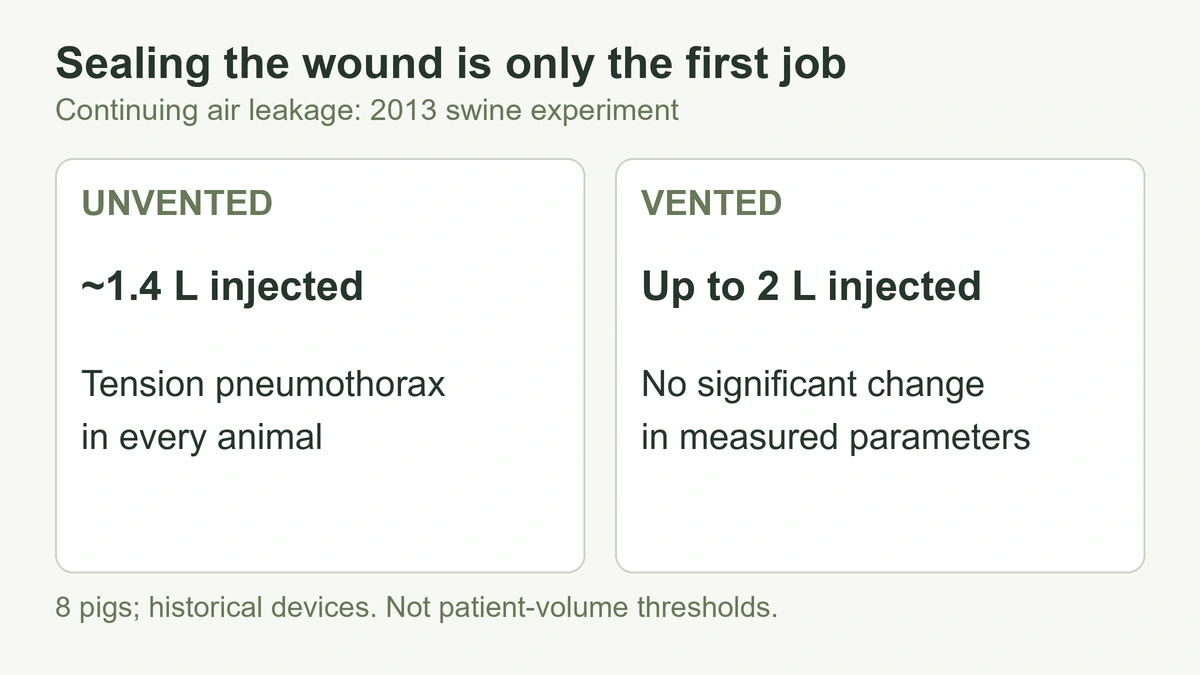
That's the whole reason a vent exists. Close the hole and do nothing else, and you've swapped an open wound for a sealed chest with a lung still leaking into it. The air has nowhere to go, and that's how tension pneumothorax starts.
Two things decide whether pressure builds:
- how much air keeps leaking from the lung after the hole is covered
- whether the seal gives that air somewhere to go
The study had eight pigs, and it tested one vented and one unvented product. It doesn't tell you how people fare, and it didn't add blood to the wound. Both points matter later.
For training, teach both halves of the problem. Air coming in through the wound is the obvious one; air that has to get out afterwards is the one that kills if nobody thought about it.
When to use a chest seal, and when not to
The guidance cited here agrees on when to use a chest seal. The Nor-Cal EMS BLS protocol, effective March 2025 and signed by its medical director, lists penetrating chest trauma "from neck to navel", on the front, side or back of the chest, plus bubbly wounds that seem to suck air and trouble breathing caused by a chest wound. The 2026 TCCC guidelines put a chest seal on every open or sucking chest wound, vented first.
Think gunshot wounds, stab wounds, fragment wounds to the torso. That's why EMS crews, law enforcement officers and tactical medics carry seals at all. Where does the seal sit in the order of care? Third. TCCC runs MARCH: massive bleeding, then airway, then respiration, and the chest seal is part of the R. So the tourniquet goes on the bleeding leg before anyone reaches for a seal for the sucking chest wound.
There's one firm exception. The National Association of EMS Physicians (NAEMSP) took this up in a paper on traumatic pneumothorax. For a patient on positive-pressure ventilation, NAEMSP's 2024 position statement says chest seals may be harmful and recommends against them. A ventilator or bag pushing air in changes the pressure picture, and the seal's job no longer fits. The Nor-Cal protocol, for its part, lists no contraindications and no precautions at all, so a protocol writer who copies only that page would miss the ventilation point. Put it in the indication line yourself.
For a spontaneously breathing patient with an open pneumothorax, the same statement goes no further than saying EMS clinicians "may consider" a vented seal. Permission, basically. TCCC was written for soldiers under fire and it's blunter: vented seal right away, non-vented if that's all you have, and keep watching for tension.
Both camps land in the same place and push with different strength. Military guidance says do it; the civilian EMS physicians say you may. Neither names a chest seal as the treatment for a wound outside the chest. For organs pushed out through an abdominal wound, TCCC uses a chest seal only to hold a non-adhesive covering in place (see the FAQ below).
Turned into a line for your own protocol, that might read: "Penetrating chest wound, neck to navel, front, side or back, patient breathing unaided: vented chest seal, or non-vented if that's all there is. Don't use on patients on positive-pressure ventilation (PPV)." Your local protocol has the final word; TCCC is military guidance and Nor-Cal is one regional system. Some civilian high-threat teams train to TECC, the civilian counterpart of TCCC, so check which one your service follows.
If you're new to the guideline itself, our explainer on مراقبتهای تاکتیکی از مجروحان نبرد (TCCC) covers how it's organized.
How to apply a chest seal
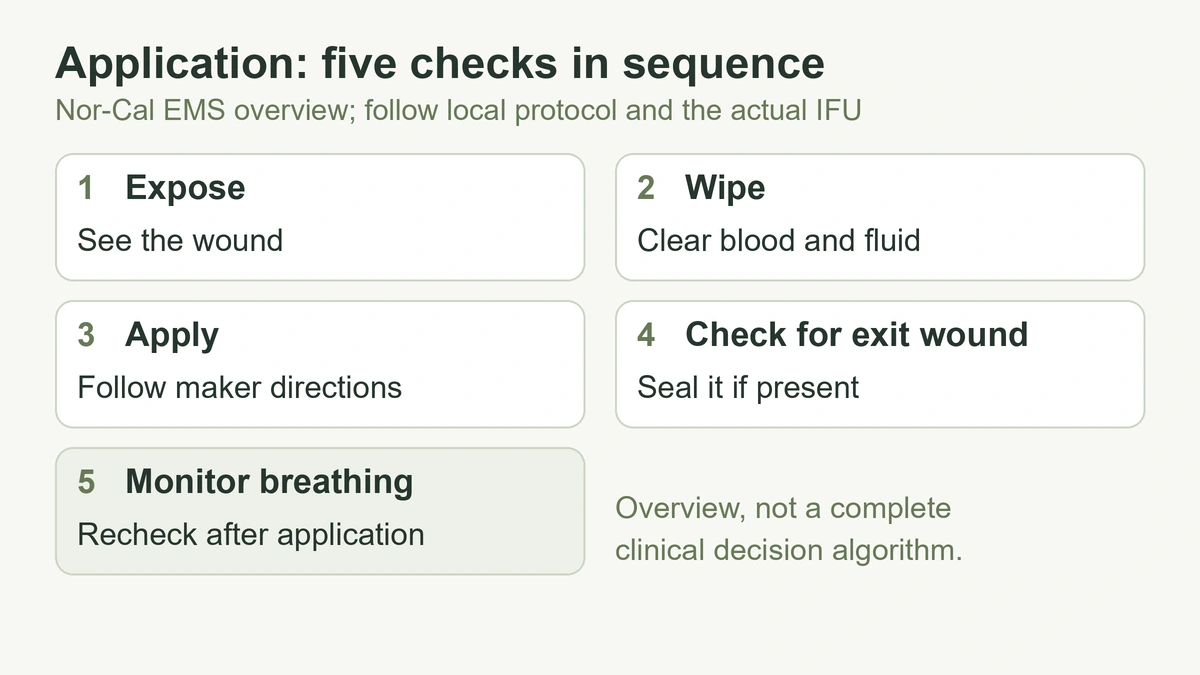
Chest seal application is short on paper. The Nor-Cal EMS BLS protocol gives the sequence in five moves:
- Expose the chest. Cut the clothing away, because a hole you can't see won't get sealed.
- Wipe the blood and fluid off around the wound site. You'll find the hole faster, and the adhesive gets dry skin to bite into.
- Peel off the backing and press the seal down over the wound the way that maker's instructions show.
- Check the opposite side and both sides of the chest for an exit wound, and seal that one too.
- Watch the breathing.
That's how to use a chest seal in the field. The wiping step deserves more respect than it gets. Adhesion is where seals fail in the studies further down, and a wet, bloody chest is the worst surface you could pick.
What about timing? Many videos and blog posts on how to apply a chest seal say to put it on as the casualty breathes out. We went through the 2026 TCCC guidelines and the Nor-Cal EMS protocol looking for it, and neither one ties the seal to the casualty's breathing. So if your instructors like the breathe-out trick, call it a habit they prefer. Calling it the rule that makes a seal work claims more than the guidance says.
Exit wounds get missed. A round that went in the front may have come out the back or under the arm, and a seal on one hole with another open hole behind it hasn't done its job. Roll the casualty, run a gloved hand along the back and armpits, look.
If you're asked how to apply chest seal models you haven't trained on, the instructions on the pack are where to look. Train from your protocol and the instructions on the pack you actually stock. Products differ in how the backing peels and where the vent sits.
After the seal is on: what to check, when to burp it, and the one-hour rule
Putting the seal on isn't the end of it. The 2026 TCCC guidelines tell responders to watch for a tension pneumothorax developing afterwards, and they name the warning signs: hypoxia getting worse, more respiratory distress, blood pressure dropping. A 2021 review in the Journal of Special Operations Medicine by Kuhlwilm went further: frequent physical checks for early signs of tension are, in the author's words, the best care.
When breathing gets worse with the seal on, the answer is to burp it or peel it off, then go to needle decompression if that doesn't help. To burp it, you lift one edge with a gloved finger, let the trapped air out, and press the edge back down. There are plenty of training clips under "burping chest seal" if you want to watch it done. How to burp a chest seal is easy to learn; the hard part is the frequent checks that tell you it needs doing. The escalation step is a skill of its own; our guide to تخلیه فشار با سوزن covers sites and landmarks.
There's one check almost nobody mentions. ITLS asks for a valve-type seal to be checked or changed one hour after it goes on. Its 2017 position explains why: blood pooling or clotting behind a one-way valve can make the valve fail, and an hour is when to look before that happens. On a long evacuation, that check falls to whoever has the casualty by then, so it has to be written down.
So a monitoring line in the protocol could look like this:
- Put pulse oximetry on and recheck breathing often.
- Worse breathing, lower oxygen, falling blood pressure? Burp the seal or remove it.
- No better after that? Needle decompression, if it's in your scope.
- Valve-type seal? Check it or change it at the one-hour mark.
- Edge lifting or sliding off? Dry the skin and replace the seal, per your protocol.
- Write the time the seal went on somewhere the next person will see it, on the casualty card or the seal itself.
If you can't tell whether the seal you carry has a one-way valve or channels, find out before the next training day. Kuhlwilm's review adds a reason to care: in the swine studies it compared, seals with flutter valves seemed to do worse than the rest.
The one-hour rule is an ITLS position for one-way valve seals, based on animal work; no study shows it changes outcomes, and it doesn't apply in the same way to channel-vented seals. Monitoring also can't fix a seal design that clogs. That's the subject of the next part.
What decides whether a chest seal keeps working: blood, vent design and adhesion
Sticking a chest seal on is the easy bit. Whether it keeps working after that comes down to the blood, and what happens once the wound bleeds under it. Two seals can both say 'vented' on the pack and still behave very differently once blood reaches the vent.
The best evidence for that came from USAISR again, in 2017. Kheirabadi's team gave 26 anesthetized pigs a bleeding chest wound (a hemopneumothorax, or HPTX, as the paper abbreviates it) and poured blood into the chest cavity. Each wound got one of five vented seals you could buy at the time. Then the team poured 50 mL more blood into the wound and injected air into the chest in steps to see which seals coped. Between them, the two valve seals worked in 1 of 8 pigs, and Sentinel and Russell each worked in all 6 of theirs.
Each design's result with blood in the wound is in the table, along with who measured it.
Vent design and adhesion results from published animal and bench studies
|
Design or condition |
Product as tested |
Result |
Study |
|---|---|---|---|
|
One-way valve, blood in the wound |
Bolin |
Worked in 0 of 4 pigs |
Kheirabadi et al., 2017 |
|
One-way valve, blood in the wound |
SAM (valve version) |
Worked in 1 of 4 pigs |
Kheirabadi et al., 2017 |
|
Laminated channels, blood in the wound |
HyFin |
Worked in 4 of 6 pigs |
Kheirabadi et al., 2017 |
|
Laminated channels, blood in the wound |
Sentinel, Russell |
Worked in 6 of 6 pigs each |
Kheirabadi et al., 2017 |
|
Three vented seals, air plus a 10% blood infusion |
HyFin, SAM, Sentinel |
All equally effective |
Kotora et al., 2013 |
|
Adhesion on blood-soiled skin (0–3 score) |
Asherman vs Bolin |
0.4 vs 2.7 |
Arnaud et al., 2008 |
|
Adhesion after ~17 h at −19.5 °C or 71.5 °C |
Russell, Fast Breathe, HyFin, SAM vs Bolin |
Four held; Bolin dropped |
Arnaud et al., 2016 |
Read the rows as results for the product versions those teams tested, years ago, in pigs. They aren't rankings of what's on sale today. What carries over is the design pattern. Sources: the studies listed under References.
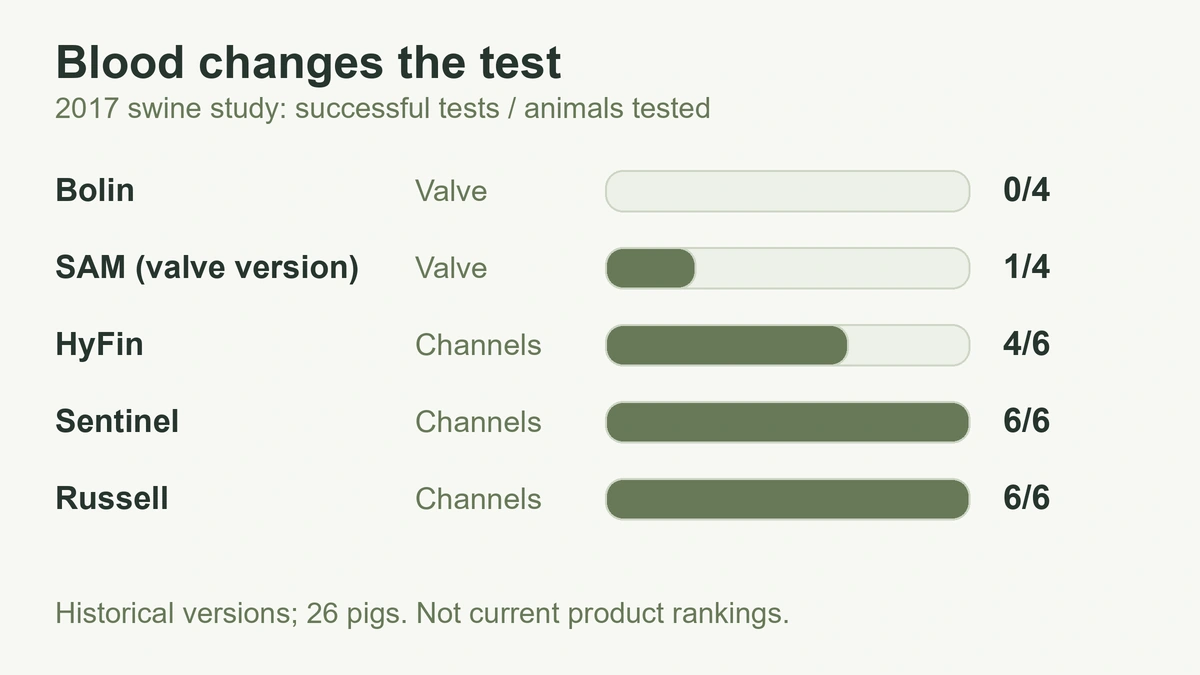
Pooled blood either lifted the valve seal off the skin (75%) or clotted inside the valve and blocked it until tension built (25%). Laminated channels let blood and air run out, so nothing pooled behind them. ITLS drew the same lesson in its 2017 position and added a point that's easy to miss: by keeping blood from collecting, the channels also kept the adhesive from failing. Vent design and adhesion aren't two separate questions.
Not every study agrees. Kotora and colleagues tested HyFin, SAM and Sentinel seals in 24 pigs with air boluses and a 10% blood infusion and found all three equally effective. Our reading, and it is a reading, is that the challenge explains the gap: Kheirabadi's team poured extra blood straight into the wound under the seal, while Kotora's protocol added a single 10% blood infusion between air boluses.
Adhesion has its own numbers. Arnaud's team at the Naval Medical Research Center scored seals from 0 to 3 for how well they stuck to swine skin. On blood-soiled skin, one older seal scored 0.4 for adherence on a 0 to 3 scale while another scored 2.7. Those adherence scores came from swine skin, and nobody has repeated them on people. In 2016 they stored five vented seals for about 17 hours at −19.5 °C or 71.5 °C, to mimic harsh field storage; four kept their grip and one didn't.
Channel shape matters too. Wells and Aho tested laminar seal designs on a bench rig in 2025 and found wider and more numerous channels moved fluid faster. (The authors disclose a financial interest held by the Mayo Foundation.)
Limitations
All of this comes from pigs and bench rigs, and no study has compared seal designs in injured people. A 2021 systematic review by Paquette and colleagues included six studies and called the evidence on individual devices limited. ITLS says plainly that there are no human studies. Products also change; a seal tested in 2017 may have been redesigned since.
So "vented" tells you the seal was designed to let something out. It doesn't tell you what happens when that something is blood. Ask how a seal vents with blood present, and how it sticks to soiled skin after storage, for the exact version you'd buy.
Vented or non-vented: which seal to stock under current guidance
TCCC has called for a vented chest seal first since 2013, and the 2026 guidelines still say so. The change came from the 2013 USAISR pig study above. As the TCCC committee's write-up of Guideline Change 13-02 put it, the question was why responders were treating a non-lethal injury with something that could produce a lethal one.
Most guidelines followed. Kuhlwilm's 2021 review compared eight international guidelines and found vented seals preferred in most of them, though two of the four civilian-oriented ones didn't prefer them. That's worth knowing before anyone tells you "every guideline says vented".
Does it matter what's in the bag? A lot. Schauer and colleagues went through the U.S. Prehospital Trauma Registry (PHTR) for Afghanistan and found 62 casualties with gunshot or puncture wounds to the chest; 46 of them got a chest seal. Most of those seals weren't vented, even though the guideline had changed partway through the period they studied. The authors pointed at training and at the supply chain. Responders use what they carry. That makes the kit audit part of the decision. Open a few kits, look at what's actually in the chest seal slot, and check the dates while you're there.
For a kit list, that turns into a TCCC chest seal line with a count you set yourself: two vented seals per casualty kit, so an entry wound and an exit wound can both be covered (Nor-Cal calls for a second seal on an exit wound). Twin packs make that easy to stock. Training seals are a separate line: teach with trainers or expired stock, and keep the vented seals in the kits for real casualties. Label the two clearly. A non-vented seal is the fallback when nothing else is available, which is how TCCC phrases it.
The full side-by-side comparison lives on our page about vented vs non-vented chest seals. If you're asking what to do with no commercial seal at all, that's a different problem; see our guide to an occlusive dressing for a sucking chest wound.
What to ask a chest seal supplier before you stock
Line up three quotes that all say 'vented' and the price is the only thing that looks different, yet none of it shows how the vent copes with blood. A dollar's gap on the quote can hide a much bigger one in how the seal vents and sticks, and in how long the glue lasts in a hot storeroom.
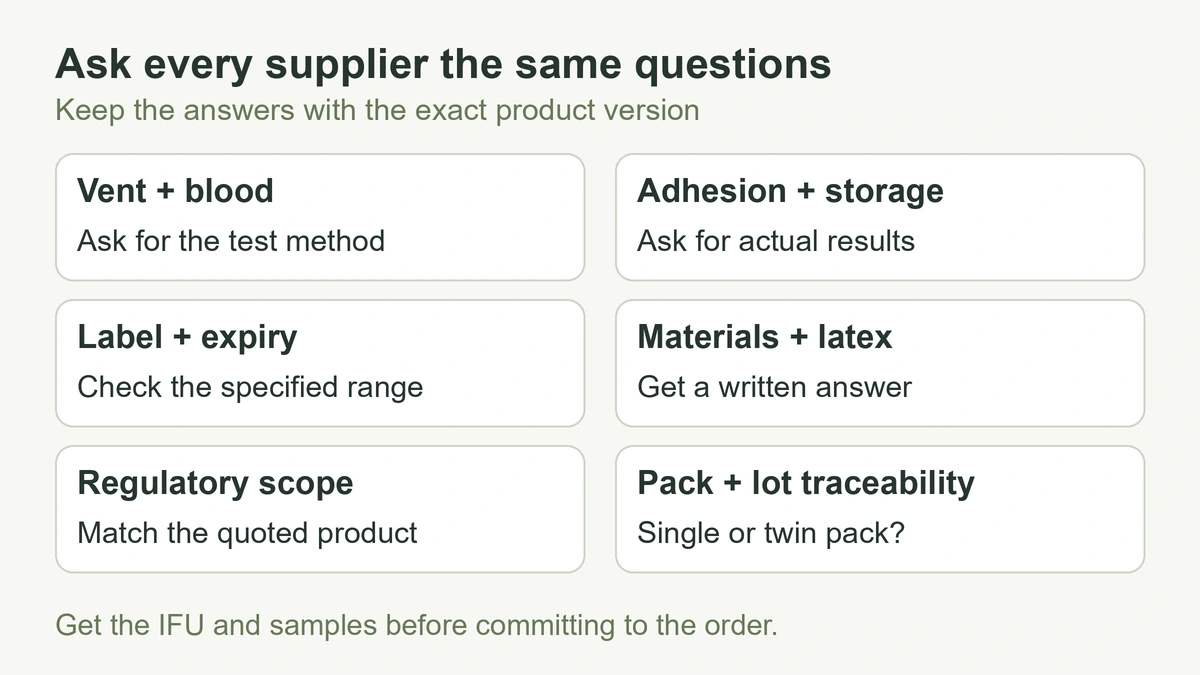
Every supplier gets the same questions, in the same order:
- Which vent design is it, valve or channels, and what venting data do they have with blood present?
- Get adhesion results on blood-soiled skin and after hot and cold storage, for the exact version you'd be buying.
- What does the label say about storage temperatures and shelf life?
- Does any part contain latex? Have them put the answer in an email.
- Regulatory status? Ask which listing covers the seal on your quote. For a sense of what one looks like, FDA has the SAM Chest Seal under 510(k) K102403, cleared in 2011, product code NAD, filed as an occlusive wound dressing.
- Single or twin pack, and are the lot and expiry printed on each one? Tell them whether the seals are going into an IFAK or a bigger trauma kit; pack size follows from that.
A seal that says "vented" and a seal that has been tested with blood under it are two different purchases. Ask which one you're being quoted.
— Rusun TacMed product team
Order samples before you commit, and keep the answers with the purchase file. If a supplier can't tell you how its vent was tested, that's an answer too. Keep in mind what the Afghanistan registry (PHTR) found: most seals placed were non-vented, and the authors pointed to the supply chain.
Read the answers with the same eye you'd use on the studies above. Was the venting test done with blood or only with air? In an animal, on a bench rig, or not at all? Which product version did it cover, and has the design changed since? If a data sheet just says "tested", with no model and no year, treat it as a blank. Then paste every supplier's answers into one spreadsheet, a row per question, and only after that let someone open the price column. Ask for the instructions for use as well; the application steps your trainers teach should match the pack you're buying. If two suppliers answer the same question in different units or on different models, go back and ask again.
Once you know which questions to ask, compare our chest seal range against them. We sell chest seals, so we have a stake in this, which is why every study and guideline here is linked. Model details are on the product page for our chest seal range, and you can request samples and a quote with the questions above attached.
سوالات متداول
Can you put a chest seal on an abdominal wound?
Not as the treatment for it. For organs pushed out through an abdominal wound, the 2026 TCCC guidelines say to cover them with something water-impermeable and non-adhesive (a bowel bag, an IV bag, clear wrap) and then hold that covering in place with an adhesive dressing, a chest seal being one example. The seal fixes the covering; it doesn't go on the organs. Nor-Cal's EMS protocol uses "neck to navel" to describe penetrating chest trauma, not wounds of the abdomen.
Will a chest seal stop bleeding?
It isn't designed to. A chest seal is not a hemostatic dressing. FDA lists one such device, the SAM Chest Seal, as an occlusive wound dressing, and in a bleeding wound the seal has to let blood out through its vent. Serious external bleeding gets controlled first in the MARCH sequence; the seal belongs to the respiration step.
Do chest seals expire?
Yes. Each pack carries the maker's expiry date. Temperature matters as well: when Arnaud's team stored seals at 71.5 °C or −19.5 °C for about 17 hours, four kept their grip and one scored significantly lower. Ask for the labeled shelf life and storage range, and check dates at every kit inspection.
چرا این را نوشتیم
Rusun TacMed supplies chest seals to distributors, training organizations and agencies. This page is for whoever specifies, stocks or teaches them, and it started from a gap in the top search results: none of the 16 pages we checked set out how valve and channel seals behaved once blood was present. None of this comes from our own testing. Every figure is from the linked studies and guidelines, and the page stops where they stop. Reviewed by Jason.
Ask us for samples and written answers
On our quote form, tick Chest Trauma and choose Sample/Trial Units for a first order. In the requirements box, tell us the seal type you want, the quantity per kit and your target market, and paste in the venting and adhesion questions above. You'll get a quote, samples and a written answer to each question, including where no test data exists. Request chest seal samples →
Related articles
- Vented vs Non-Vented Chest Seal: Protocol Selection Guide: how the two seal types compare when you set the mix for kits and tenders.
- Sucking Chest Wound Occlusive Dressing Guide: what goes on the wound when there's no commercial seal, and why gauze won't do.
- ARS vs TPAK Decompression Needle: Which 14G Is Right?: the needle that sits next to the seals in the kit, for when tension builds anyway.
- Needle Decompression vs Chest Tube: Field Kit Comparison: what comes after the needle, and which one belongs in a field kit.
مراجع
- Vented versus unvented chest seals for treatment of pneumothorax and prevention of tension pneumothorax in a swine model. Kheirabadi BS et al. Journal of Trauma and Acute Care Surgery 75(1):150-6, 2013.
- Do vented chest seals differ in efficacy? An experimental evaluation using a swine hemopneumothorax model. Kheirabadi BS et al. Journal of Trauma and Acute Care Surgery 83(1):182-189, 2017.
- Vented chest seals for prevention of tension pneumothorax in a communicating pneumothorax. Kotora JG Jr et al. Journal of Emergency Medicine 45(5):686-94, 2013.
- Evaluation of chest seal performance in a swine model: comparison of Asherman vs. Bolin seal. Arnaud F et al. Injury 39(9):1082-8, 2008.
- Adherence evaluation of vented chest seals in a swine skin model. Arnaud F et al. Injury 47(10):2097-2104, 2016.
- Management of Open Pneumothorax in Tactical Combat Casualty Care: TCCC Guidelines Change 13-02. Butler FK Jr et al. Journal of Special Operations Medicine 13(3):81-86, 2013.
- The Use of Chest Seals in Treating Sucking Chest Wounds: A Comparison of Existing Evidence and Guideline Recommendations. Kuhlwilm V. Journal of Special Operations Medicine 21(1):94-101, 2021.
- Efficacy of Commercial Chest Seal Adherence and Tension Pneumothorax Prevention: A Systematic Review of Quantitative Studies. Paquette R et al. Journal of Special Operations Medicine 21(3):78-85, 2021.
- قرار دادن چسب سینه برای زخمهای نفوذی قفسه سینه توسط نیروهای امدادی زمینی پیشبیمارستانی در افغانستان. Schauer SG et al. Journal of Special Operations Medicine 17(3):85-89, 2017.
- Prehospital Trauma Compendium: Traumatic Pneumothorax Care: Position Statement and Resource Document of NAEMSP. Lyng JW et al. Prehospital Emergency Care, 2024.
- Comparison of Novel Chest Seal Designs to Commercially Available Chest Seals at Relevant Physiological Pressures. Wells N, Aho JM. Journal of Special Operations Medicine 25(1):17-22, 2025.
- Tactical Combat Casualty Care (TCCC) Guidelines, 1 May 2026. Committee on Tactical Combat Casualty Care.
- Chest Seals for Open Pneumothorax: Resource Document and Current Thinking. International Trauma Life Support, 2017.
- 1811 BLS Chest Seal. Nor-Cal EMS Policy & Procedure Manual, effective 03/01/2025.
- 510(k) Premarket Notification K102403: SAM Chest Seal. U.S. Food and Drug Administration.


