
table of contents
A needle decompression buys minutes. A chest tube ends the emergency. The needle decompression vs chest tube question is really about sequence, not selection—one device hands the casualty to the other, and mixing up their roles produces two expensive mistakes: kits specced with equipment nobody on scene may use and tenders that treat a life-critical catheter like a commodity cannula.
Most of what ranks for this comparison is written for the clinician at the bedside. Fair enough—but if your job is filling 500 trauma kits, the bedside answer is only half the question. The other half—what the failure data means for the device you put in the kit—is the half that decides tenders.
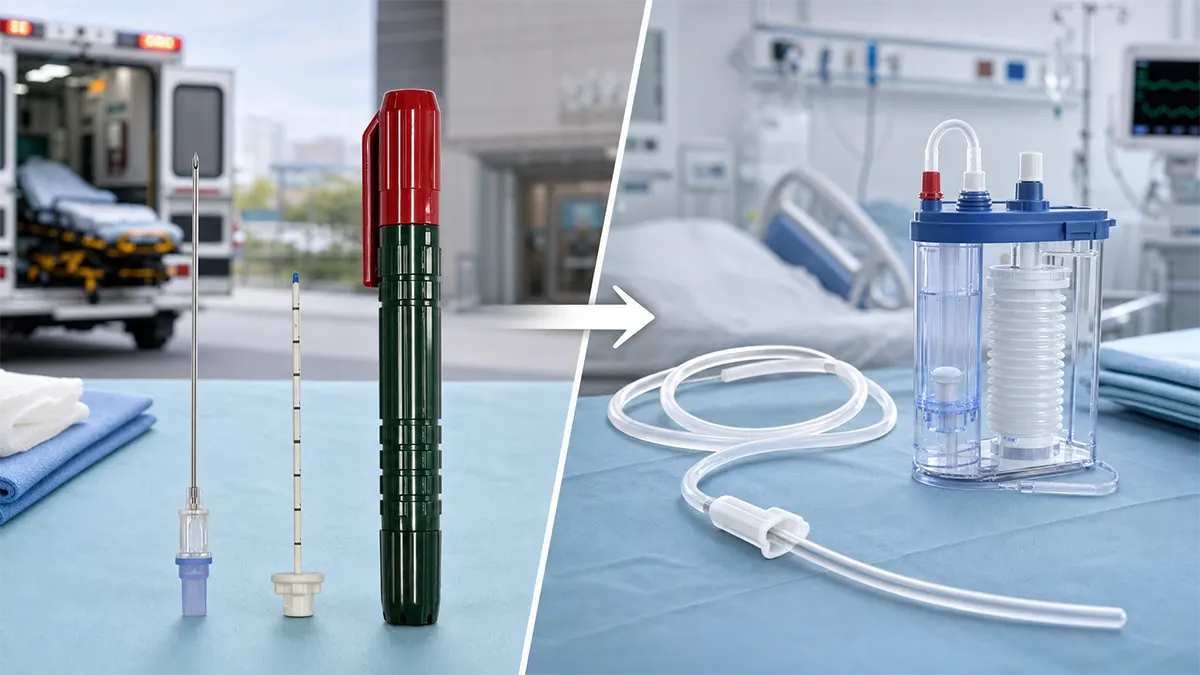
| Item | Needle decompression (NCD) | Chest tube (tube thoracostomy) |
|---|---|---|
| What it is | 14G or 10G × 3.25 in (8 cm) catheter-over-needle | Surgical drain placed through an incision in the chest wall |
| Clinical job | Vents trapped pleural air—converts tension pneumothorax into a survivable simple pneumothorax | Definitive drainage and lung re-expansion |
| Time on task | Under a minute for a trained provider | A surgical procedure with a sterile field, then days of drainage management |
| Who performs it | Combat medics, paramedics, EMS under protocol | Physicians and surgical teams (protocol-dependent) |
| Where it happens | Point of injury, field, transport | Emergency department or hospital |
| Kit status | Sealed single-use trauma-kit line item | Facility equipment — not an IFAK item |
One Casualty, Two Devices, One Sequence
Needle decompression and chest tube placement are consecutive steps on the same casualty timeline, not rival treatments.
The emergency behind both is tension pneumothorax: air escaping into the pleural space with no way out, building pressure that collapses the lung and chokes blood return to the heart. Untreated, it progresses to cardiac arrest—which is why the response cannot wait for a hospital.
The needle goes first. A large-bore catheter-over-needle punctures the chest wall and vents the pressure. The needle comes out, and the catheter stays behind as the escape channel. That is a temporizing move. Per the StatPearls trauma reference, immediate needle decompression is indicated for the unstable casualty, followed by imaging and chest tube thoracostomy once the patient reaches definitive care. The tube finishes the job—StatPearls puts chest tube thoracostomy’s resolution rate at roughly 90% of pneumothorax cases.
Between those two events sits what we call the Hand-Off Window — the stretch between the field puncture and the hospital tube. It may be twenty minutes in an urban EMS system or several hours in a tactical evacuation chain. Every quality argument about decompression needles—bore, length, and catheter stiffness—is at bottom an argument about surviving the hand-off window.

Key takeaway: you are not choosing between these devices. You are equipping the first half of a two-step chain and trusting the second half to the receiving facility.
Speed, Skill, and Staying Power: The Working Differences
Speed is the needle’s whole case. A trained medic can decompress a chest in under a minute with a sealed device pulled from a pouch. A chest tube is surgery: incision, blunt dissection into the pleural space, tube placement, securing, and drainage management for days afterward. Nothing about that belongs at a point of injury.
Does a chest tube always follow needle decompression?
In trauma care, treat the answer as yes. The needle converts the immediate threat but does not treat the underlying injury; the casualty still needs definitive drainage, plus evaluation of whatever the needle itself did on the way in. The consequence for planners: every needle decompression implies a downstream hospital handoff, so evacuation timelines—not device marketing—set what the catheter must endure.
Why does needle decompression fail in the field?
Mostly because the hardware was never specced for the job.
⚠️ Field data: the EMCrit review of the imaging literature notes that standard IV catheters—around 5 cm—fail to reach the pleural space in up to 65% of adults and that even a correctly placed cannula can kink, occlude, or dislodge during movement. The military’s answer, written into current TCCC guidance through the CoTCCC change package published in the Journal of Special Operations Medicine, is a 14-gauge or 10-gauge needle/catheter unit at 3.25 in (8 cm), with two approved insertion sites. Site selection and landmarks are their own topic; one line here does not do them justice.
The buyer’s translation: the needle only opens the door. The catheter is the part that has to survive.
Why Trauma Kits Stock Needles, Not Chest Tubes
Three walls separate a chest tube from a packing list, and none of them are price.
Skill scope. In most EMS and military systems, chest tube insertion sits at physician level, while needle decompression sits within medic and paramedic protocols. A kit item nobody on the scene is authorized to use is dead weight with an expiration date. (Some physician-staffed critical-care and HEMS services do place tubes in the field — if that describes your program, your medical director already knows it.)
Logistics. An NCD is one sealed, shelf-stable, pocket-sized unit. A chest tube setup is a sterile surgical tray plus suction and drainage hardware—storage and sterility demands that make no sense in an IFAK or a vehicle kit.
Kit architecture. Under the MARCH assessment framework, airway support starts before the R step; teams that stock adjuncts can review our nasopharyngeal airway kit page for NPA sizing and kit options. The R covers respiration with two complementary line items: vented chest seals close the penetrating wound, and the decompression needle releases the trapped air a seal cannot reach. The tube has no slot in that architecture — it belongs to the facility at the end of the evacuation chain.
Which seal configuration belongs in that kit line — vented, non-vented, or a pair — is covered in our vented vs non-vented chest seal guide.
Can combat medics or EMS place chest tubes?
At standard certification levels, generally no — and procurement should assume no unless the program’s medical direction says otherwise. TCCC’s own tiering makes the point: needle decompression appears in the medical personnel curriculum, not the all-combatants one. That is also a stocking rule. Match kit contents to who is actually trained, or the line item is theater.
Key takeaway: the kit carries the needle; the evacuation chain provides the tube.
Reading the Failure Data Like a Buyer
The same three variables show up in every failure review—bore, usable length, and how the catheter behaves after the needle comes out. That makes the RFQ unusually easy to write. Four lines to verify on any decompression needle before a bulk order:
- Usable catheter length: 3.25 in / 8 cm. Short IV-style cannulas are the documented failure mode, not a budget option.
- Bore: 14G standard — 10G only where your protocol specifies it.
- Catheter material and kink resistance, stated on the datasheet. A device that decompresses once but collapses during transport fails inside the handoff window—exactly where there is no backup.
- Lot/batch coding and per-batch QC documents. In tenders we have quoted, documentation questions—batch coding, QC records—decide rejections as often as the device does.

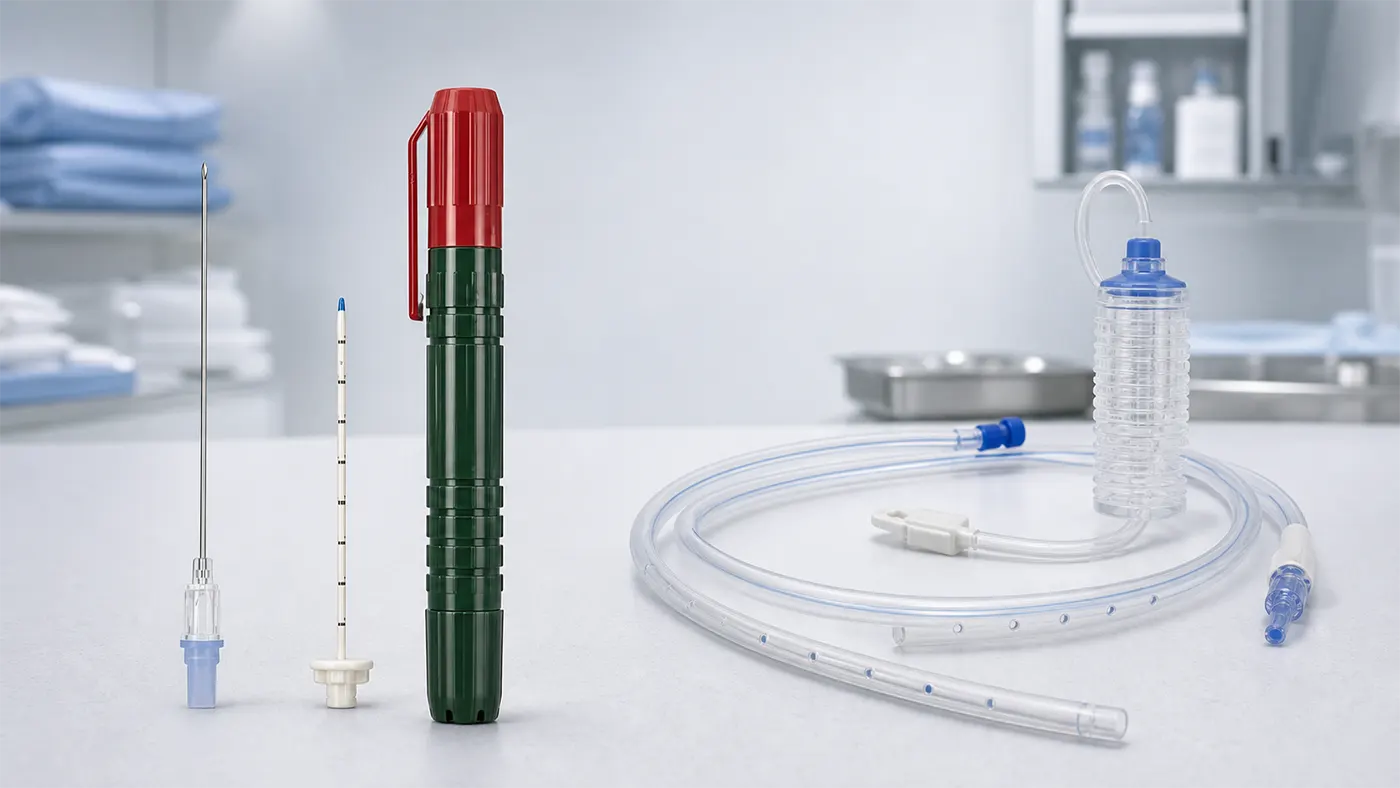
We manufacture this device in ten case configurations on one needle: a 14G × 3.25 in catheter-over-needle NCD, each supplied with its own protective case. The needle is the constant; the case, the attachment point and the pack unit are what you choose. If your protocol calls for 10G or pediatric sizes, ask us directly — we would rather tell you honestly what we can supply than relabel what we have.
Before You Sign Off on the Packing List
- Stock the needle, plan for the tube. The kit’s job ends at the hospital door; buying “more definitive” field equipment usually means buying unusable equipment.
- Spec the catheter, not the needle. 14G × 8 cm, with kink behavior on paper. The puncture is easy; staying open through evacuation is the product.
- Match contents to training tier. Needle decompression is a medical-personnel skill in TCCC’s structure—kits for untrained carriers do not need it.
- Put documentation in the RFQ. COA, batch coding, IFU, and export papers cost nothing to ask for up front—and everything to discover missing at customs or tender review.
Frequently Asked Questions
What size decompression needle do trauma programs standardize on?
14 gauge × 3.25 in (8 cm) is the standard adult configuration, and current TCCC guidelines also permit a 10-gauge unit at the same length. Anything built around a short, standard IV catheter is not a substitute—reach is the documented failure point. Pediatric programs use shorter, smaller-bore devices specified separately.
What paperwork should a bulk NCD order include?
Ask for the COA, the lot/batch coding scheme, the IFU, sterility and shelf-life statements, and the export set: certificate of origin, commercial invoice, packing list, and HS code. Missing documents stall shipments at customs more often than device faults do—and tender reviewers read the paperwork before they open a sample.
Is one decompression needle per kit enough?
Set the number by protocol, not price. TCCC guidance allows repeat decompression if tension physiology returns during evacuation, which is why many medic-level loadouts carry more than one unit. A program with long evacuation timelines inside the Hand-Off Window has a different answer than an urban EMS service—that call belongs to your medical direction.
Can you private-label decompression needles for our kit line?
Yes, subject to MOQ. Packaging and the protective case can carry your branding, and we assemble kit configurations against your bill of materials. Send the BOM and branding files with your RFQ, and the quote will include OEM lead times.
Next step: pull our 14G NCD spec sheet and compare its catheter line against the four checks above—then send the same four questions to every other supplier on your shortlist — including branded devices; see our ARS vs TPAK vs generic sourcing comparison. If the answers differ, you have your decision. Request the spec sheet and bulk pricing here.
— Rusun TacMed Technical Supply Desk
About This Guide
Reviewed by the Rusun TacMed Technical Supply Desk. We manufacture the needle side of this comparison—a single 14G × 8 cm chest decompression needle—and no chest tubes; that is exactly why this comparison can be honest about where each device belongs. Clinical statements are drawn from the public sources below and are provided for procurement context, not clinical guidance: protocol questions belong with your medical director. Last updated: 2026-07-02.
References & Sources
- Tension Pneumothorax — StatPearls, NCBI Bookshelf — National Library of Medicine
- Needle vs. Knife II: Needle Thoracostomy — EMCrit — Scott Weingart, MD
- Management of Suspected Tension Pneumothorax in Tactical Combat Casualty Care — CoTCCC change package, Journal of Special Operations Medicine (2018), hosted by NAEMT
- Needle Decompression of Tension Pneumothorax: TCCC Guideline Recommendations — Military Health System (health.mil)


